
Live Nation Meets Its Match In Landmark Antitrust Ruling
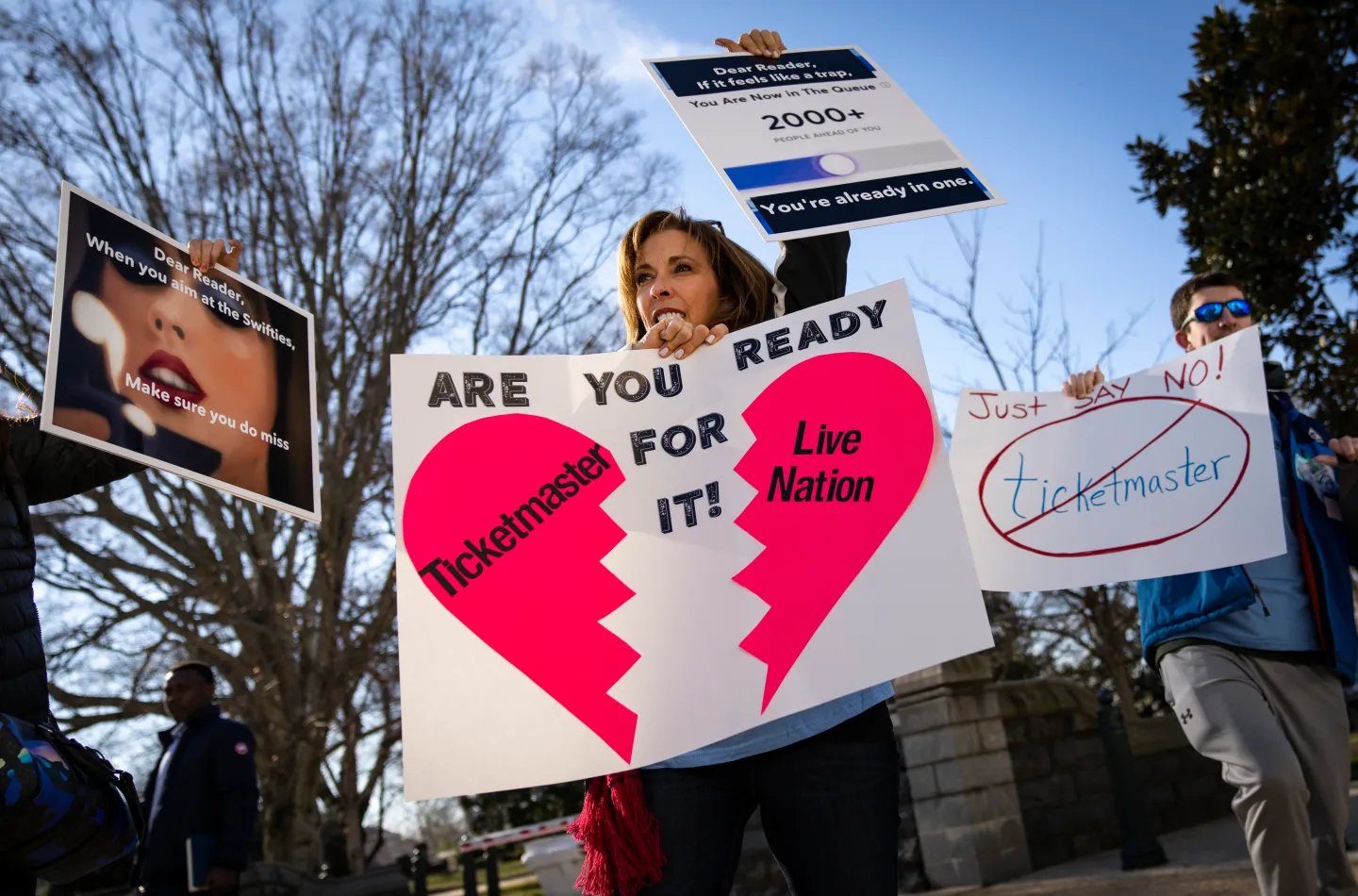
Protesters hold up signs calling for the dissolution of the Ticketmaster and Live Nation monopoly. Source: Vox.
On April 15, a jury in the Southern District Court of New York found Live Nation Entertainment, the leading enterprise in the live event space, guilty of violating antitrust laws. The case unfolded in Manhattan, and the U.S. District Judge Arun Subramanian presided over the matter.
In this case, it was established that although Live Nation and Ticketmaster technically operate as a single business entity, the two platforms were found to be forming an illegal monopoly. Live Nation Entertainment kept the two platforms running separately, with Ticketmaster primarily being used for ticket sales, and Live Nation for general concert promotion, special sponsorships, and merchandise sales. This consolidation of market power allowed Live Nation to achieve extremely high profits at every stage of the live event production process. However, this business success, especially in recent years, came at the buyers’ expense.
The company has long received criticism for raising ticket prices. However, when looking at the intricacies of Live Nation’s business model, a few key components have contributed to increased buyer frustration. Most notable is Live Nation’s dynamic pricing feature, which causes ticket prices to fluctuate in real time depending on buyer demand. This has caused especially stressful predicaments for consumers, who, upon getting to the front of the queue, are met with unreasonable prices for the remaining seats.
The plaintiffs in the suit were the U.S. Department of Justice and the attorneys general from 39 states and the District of Columbia. They proved that Live Nation was guilty of engaging in anticompetitive practices by showing that the company controlled 80% of the nation’s major concert venues.
Most notably, attorneys presented Live Nation communications demonstrating that the company exerted intimidating pressure on concert venues to use their ticketing services and threatened to withhold popular artists if venues chose other ticketing services.
These pieces of evidence also conveyed exclusionary intent, showing that the company aimed to block competitors from growing in the market rather than simply outperforming them. For example, a call between Live Nation CEO Michael Rapino and the CEO of Barclays Center in New York, John Abbamondi, revealed how Rapino threatened that the Barclays Center would struggle to put on future shows if Abbamondi stopped using Ticketmaster’s services. Abbamondi called to inform Rapino that the venue wanted to switch to using SeatGeek.
Finally, in court, Live Nation’s damage to consumers and its malicious attitudes were heavily discussed. Internal Slack Messages written by Live Nation executive Ben Baker called customers “stupid,” with Baker saying the company was essentially “robbing them blind.”
Furthermore, the jury found that for individuals in 22 states, Live Nation was overcharging by $1.72 per ticket. However, Judge Subramanian shared that exact financial penalties for Live Nation’s practices will be issued at a later date.
This type of lawsuit has unfolded, most recently involving mismanaged ticket sales for Taylor Swift’s Eras Tour. Fans waited in queues for hours just to never get a chance to purchase tickets. Tours for other high-demand artists in the U.S., including Ariana Grande and Sabrina Carpenter, have also experienced these issues.
Although not a formal lawsuit, a similar failed ticket rollout occurred in the U.K. in 2024, leading to heavy public backlash. Consumers who tried to buy tickets for the rock band Oasis’ reunion tour were outraged by Ticketmaster’s use of dynamic pricing. Afterwards, Ticketmaster put out a statement agreeing to be more transparent about ticket prices in the future. With the recent District Court ruling, that promise might actually be met.
What does this mean for consumers? Right now, the path forward is somewhat unclear. Unfortunately, consumers will not receive immediate compensation for past overcharges in ticket sales since this was a government antitrust case and not a class action lawsuit. However, the ruling ultimately brings a glimmer of hope for concertgoers and increases pressure on Live Nation to end dynamic pricing and enact structural changes to its business model.
In terms of pricing specifically, Live Nation will likely shift to transparent, all-in pricing, where ticket prices do not fluctuate unreasonably when tickets go on sale. With this change, consumers will be able to assess original ticket prices at face value.
Additionally, there is now greater potential for expansion of the ticket sales market. There is more room for existing runner-up companies, such as StubHub, Eventbrite, and SeatGeek, as well as potentially new companies, to break into the market.
Depending on future court outcomes, a clean split between Live Nation and Ticketmaster could potentially follow. However, Live Nation has expressed its plans to appeal the recent Manhattan verdict. “The jury’s verdict is not the last word on this matter,” Live Nation said in a recent statement.
Overall, this antitrust case will redefine concert experiences for years to come. While future steps are still to be determined, the ruling is a significant stride towards creating a more equitable marketplace for both music artists and their fanbases.