
White House Considering Plan to Reshape Health Research
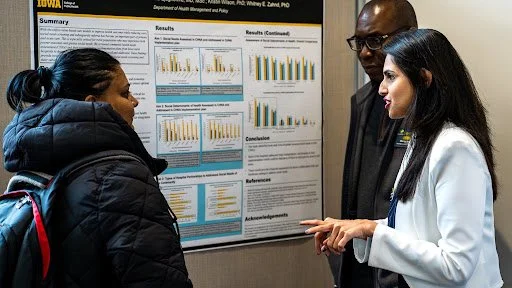
NIH grants support research into virtually every aspect of public health, including disease prevention, healthcare access, social determinants of health, and disparities in outcomes. Source: University of Iowa College of Public Health.
In 2023, the conservative think tank, The Heritage Foundation, published its dream plan for a second Trump presidency in an initiative titled Project 2025. The foundation wrote, “funding for scientific research should not be controlled by a small group of highly paid and unaccountable insiders at the NIH (National Institutes of Health).” Three years later, the Trump Administration has begun a push to shift oversight of NIH grants to a politically appointed committee.
On September 20, The New York Times reported that the White House Office of Management and Budget (OMB) has begun drafting an order to delegate the NIH’s $30 billion grant program to a politically appointed committee. The White House has often cited influences from the political left in research and academia, making the executive order a continuation of a fight to align innovation with the current administration’s priorities. By ostensibly fighting political influences in the NIH through the creation of a politically appointed committee—essentially fighting fire with fire—this policy represents the furthest step yet by the White House to claim greater control over grantmaking.
Importantly, while the administration has paused plans to release the order, the White House remarked that it remains an option on the back burner.
The Trump Administration has been particularly and publicly concerned with NIH grants for research into health disparities. NIH director and Trump appointee, Dr. Jay Bhattacharya, specialized in this field at Stanford. Bhattacharya seems opposed to the recent push to shift funding decisions away from his team. In doing so, the NIH director has been forced to thread a fine needle. On one hand, he has assured the White House that the NIH is free of academia’s liberalism. On the other hand, he has touted the importance of researching health disparities.
Even at its peak in the Biden Administration, health disparity research received under $1 billion per year, a relatively small piece of the NIH’s total expenditure at just 2%. Despite this small quantity, and perhaps explaining Bhattacharya’s firm defense, such public sector investment is faced with making up for inequalities in the billions of dollars of private funding that overwhelmingly favor public health threats to “the majority of Americans”—that is to say, white Americans.
In fact, quantitative analyses of health innovation funding show that private sector investments tend to focus heavily on commercial drugs and high-margin products that disproportionately target diseases with higher prevalence among white populations, while ignoring population-level health research. That has contributed to a society where, among health-focused companies, the revenues of black-led organizations are 45 percent smaller than those of their white-led counterparts.
To some extent, the NIH mandate is to reduce the gap and invest in a more diverse set of research areas than would otherwise be given priority. In fact, the NIH was created to catalyze solutions to the country’s most pressing public health issues, which can disproportionately impact people of color. Many research projects studying public health issues in the communities where they occur can get framed as equity projects, minimizing the magnitude of health disparities and underrepresentation in health research.
As the White House reconsiders issuing an executive order, it is worth monitoring whether NIH begins to align its grantmaking with the current administration’s requests. Dr. Bhattacharya and other NIH officials are likely to respond in one of two ways: defensively, or proactively.
The first is defensive. NIH leaders could resist any future executive order that could displace their oversight in any grantmaking decisions. The second is proactive. They could cut grants for minority research in advance, believing the policy may be proposed again. In either scenario, health equity research could see another hit if grants are suddenly paused or slowly phased out.
Either outcome would add to the loss of research independence and funding over the last two years. This could potentially weaken the role of America’s public sector as a public health pioneer.