
Alabama Redistricting Blocked
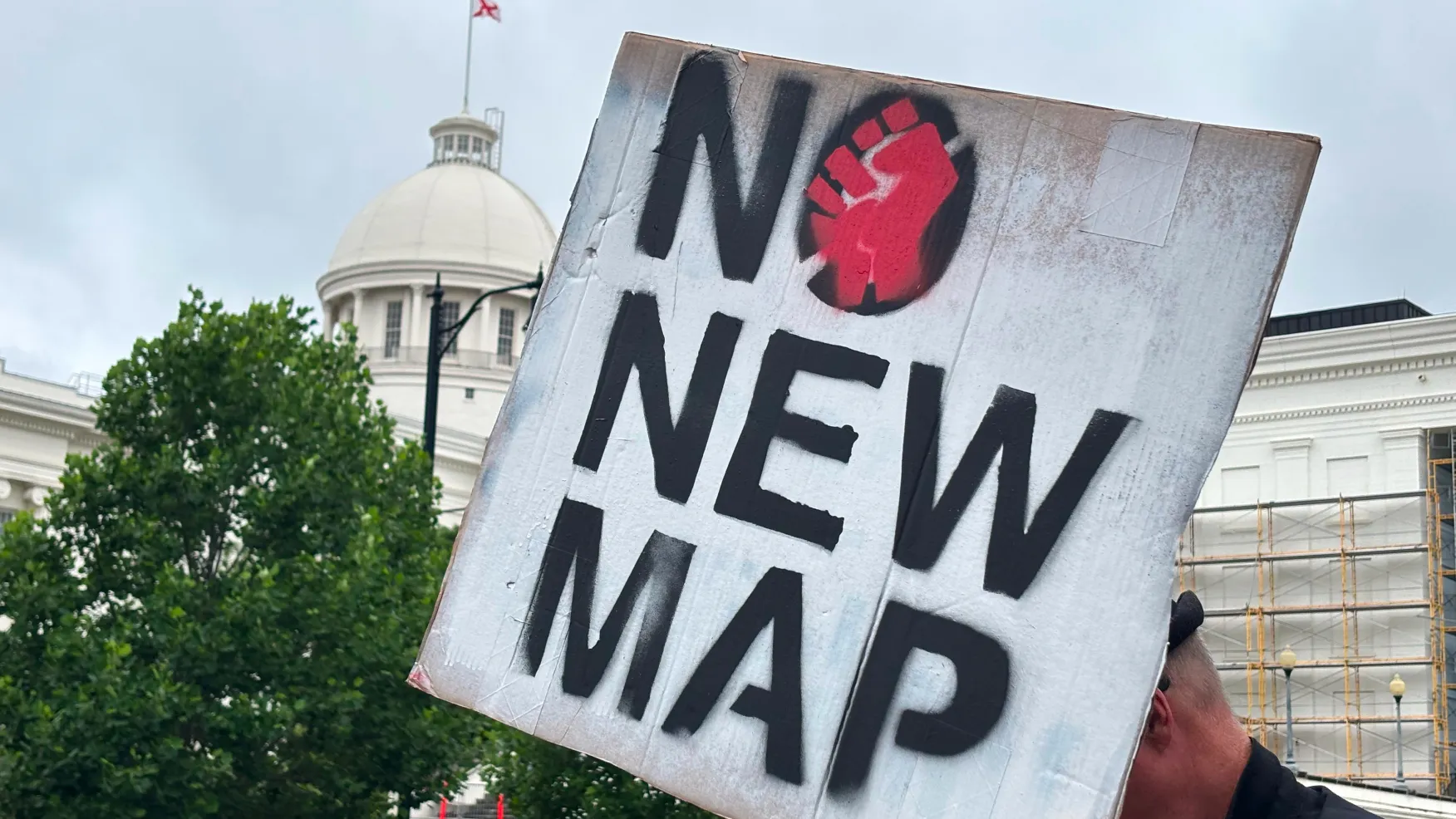
A demonstrator holds up a sign outside the Alabama Statehouse in Montgomery, Alabama. Source: WJHL.
A federal three-judge panel on Tuesday blocked Alabama from deploying a Republican-drawn congressional map for the 2026 midterm elections, finding that the plan “intentionally discriminated based on race in violation of the Constitution.” This ruling preserves a Democratic-held seat and reopens a five-year-long legal confrontation over voting rights in the Deep South. The case’s procedural history can make the ruling legible as something other than a simple win for voting rights advocates. A court-appointed special master had previously drawn a remedial map, which the district court ordered the state to use after finding in 2025 that Alabama’s map was “an intentional effort to dilute Black Alabamians’ voting strength.” Alabama appealed to the Supreme Court, which in May wiped away the lower court decision and remanded the case for reconsideration under Louisiana v. Callais. The court’s ruling significantly narrowed how Section 2 of the Voting Rights Act should be applied. The state read that remand as a green light to revive its older, Republican-favored map. Tuesday’s panel disagreed, ruling that Callais does not immunize a map already adjudicated as intentionally discriminatory under the Fourteenth Amendment. The panel held that “Alabama cannot use Callais to legitimize its pre-Callais decision to double down on the discriminatory vote dilution that the Supreme Court and we found.” Alabama’s attorney general, Steve Marshall, has indicated he will appeal immediately, and the Supreme Court will almost certainly face the question of whether its own remand order provided a basis for the outcome the district court reached. Republicans argue that it did not, and that the majority in Callais intended to clear space for maps like Alabama’s by rebalancing the state's redistricting interests against minority-voter claims. Voting rights advocates contend that intentional racial discrimination under the Equal Protection Clause is not a question Callais addressed at all. The practical stakes are narrow but immediate. The Republican map would have given the GOP a chance to reclaim the seat currently held by Democratic Representative Shomari Figures. But nationally, roughly half a dozen Republican-led states have enacted new voting districts since President Trump urged Texas to redraw its maps last summer. This represents a broader pattern of Republican efforts to protect their slim House majority. Democrats, meanwhile, have countered with new districts in California and expect gains from court-imposed maps in Utah. What Tuesday's ruling reveals is not that the courts have settled the redistricting wars; they haven’t, but that Callais’s reach is still being negotiated in real time. Whether the Supreme Court views its own remand as implicitly licensing maps it has previously called discriminatory will define not just Alabama's congressional map, but the outer limits of what post-Callais redistricting can look like across the South.