
Procedures Without Authority
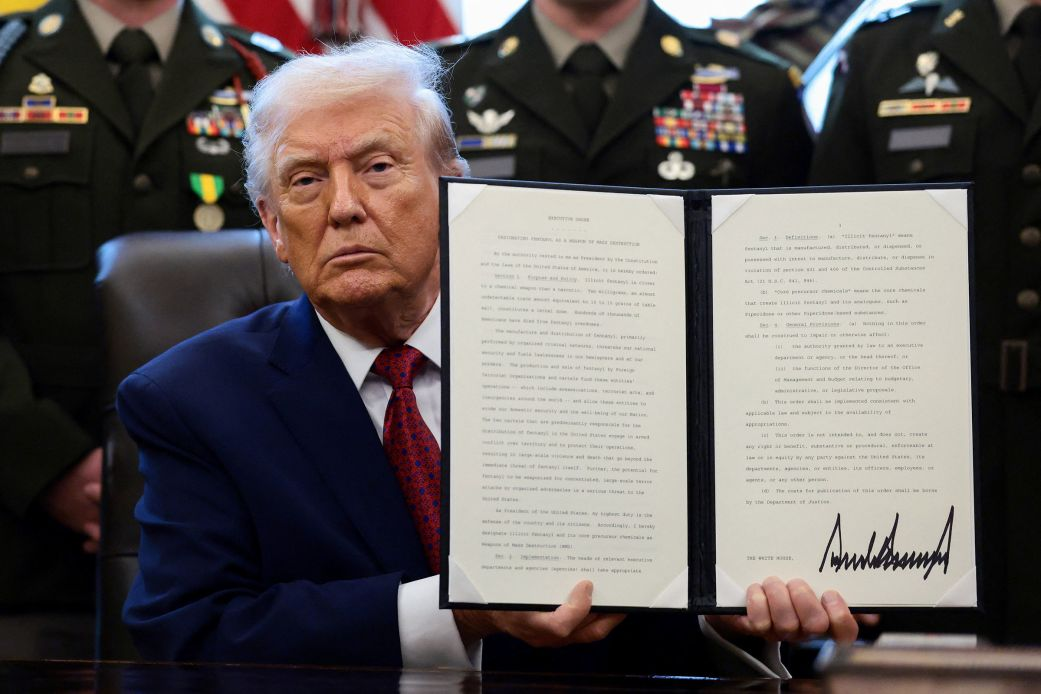
President Donald Trump shows a signed executive order classifying fentanyl as a “weapon of mass destruction” during an event in the Oval Office. Source: CNN.
The U.S. military carried out another strike on a boat allegedly being used to smuggle drugs in the early hours of Saturday morning in the Eastern Pacific Ocean. This attack marks the fourth attack on suspected drug smugglers by the U.S. this week, and represents the latest in a campaign of U.S. strikes that began in early September. U.S. Southern Command announced that 3 suspects were killed during the attack, bringing the death toll to 205 since President Trump declared an “armed conflict” with Latin American drug cartels. That declaration is very important for the legal grounding surrounding these military actions. Outside of a recognized armed conflict, international law requires states to prioritize arrest and interdiction over lethal force, which would render these strikes presumptively unlawful. The administration has not identified a specific statutory authorization for the campaign, instead asserting generalized national security authority and cartel-terrorism links. Human Rights Watch argues that the “narco-terrorist” designation does not itself create legal authority to kill, and that even within an armed conflict framework, the law requires distinction, proportionality, and military necessity – none of which can be assessed without disclosure of targeting intelligence. The administration counters that the campaign is authorized under a Justice Department opinion granting personnel immunity from prosecution. The campaign’s rationale faces an even greater challenge when looking at the empirical data surrounding drug smuggling. CBP cocaine seizure data shows roughly 47,800 pounds seized from September 2025 through April 2026, up from 43,300 pounds in the equivalent pre-campaign period, which is the opposite of what the Trump administration has claimed: a near-eradication. Additionally, the Pentagon Inspector General announced a self-initiated review of whether the military followed its established targeting framework, but explicitly stated it will not probe the legality of the strikes. That narrow mandate means the review can evaluate whether procedures were followed without asking whether the procedures themselves are lawful. Eight months into a campaign that has killed 205 people in international waters without a single public identification of the dead, the gap between procedural and legal accountability remains the defining unresolved question.