
Extremely Likely to Vote, Historically Less So
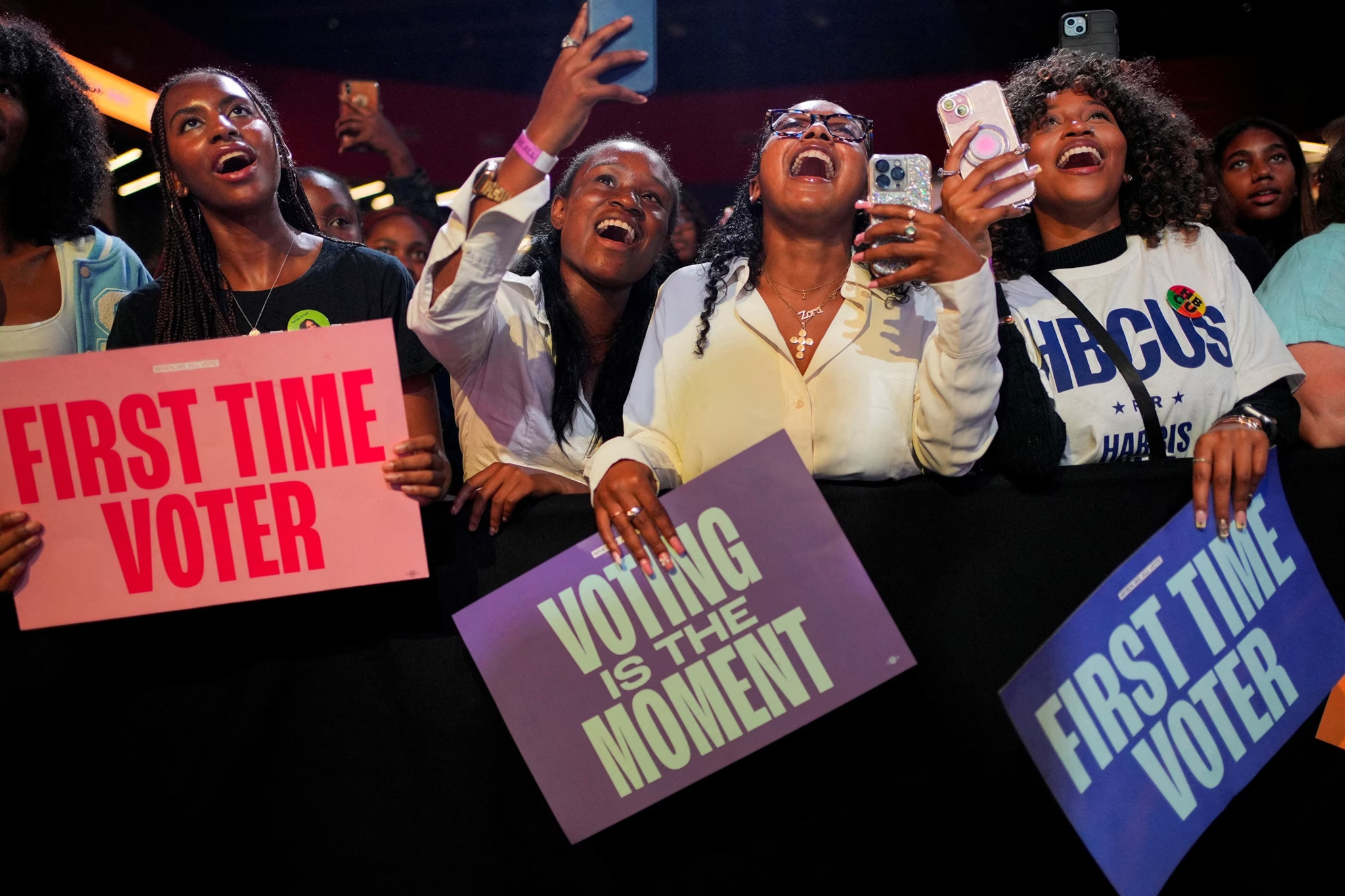
First-time youth voters supporting Kamala Harris during the 2024 election. Source: ABC News.
Nearly 50 million Americans ages 18 to 29 are eligible to vote in the November 3 midterm elections, according to the Center for Information and Research on Civic Learning and Engagement (CIRCLE) at Tufts University. This includes about 8.5 million people who have aged into the electorate since 2024. Whether those voters decide any outcomes seemingly depends less on their number than on which of them show up to the polls.
Youth turnout in midterm elections hovered around 20 percent for decades, according to CIRCLE, before jumping to 28 percent in 2018 and 23 percent in 2022. Early indicators for 2026 look strong for young voter turnout. In a 2026 survey by CIRCLE and When We All Vote, 56 percent of young people ages 18 to 29 said they were extremely likely to vote. However, CIRCLE itself cautions against treating that as a forecast, and comparable measures have overshot before. In a September 2018 poll, 34 percent of young people said they were extremely likely to vote, but actual turnout was 28 percent. CIRCLE also notes that the survey likely overrepresents civically engaged young people.
The more revealing number is how enthusiasm divides. In the same survey, 68 percent of young Democrats said they were extremely likely to vote, compared with 49 percent of young Republicans and 38 percent of independents. CIRCLE links part of that gap to dissatisfaction: 81 percent of young Democrats said the country is headed in the wrong direction, against 21 percent of young Republicans. Yet, 65 percent of independents also said that the country is on the wrong track. The largest reservoir of youth discontent may therefore sit with the group least likely to vote, which suggests the youth vote’s impact could hinge less on persuasion than on whether frustration manifests as participation. Democrats’ apparent advantage is also less secure than it looks. CIRCLE reported that young Democrats turned out at lower rates in 2024 than in other recent cycles, and that the youth electorate was more Republican and conservative than in previous elections.
Geography matters as well. CIRCLE estimates that young voters backed John Fetterman over Mehmet Oz 70 percent to 28 percent in Pennsylvania's 2022 Senate race, giving Fetterman a net advantage of about 120,000 votes among that group. That is more than half of his roughly 220,000-vote margin of victory statewide. Registration data, however, do not point to a sweeping surge. As of July 1, 2026, youth registration across 42 states was 1 percent higher than at the same point in 2022. Utah (27 percent) and Minnesota (19 percent) posted large increases, while Louisiana, Kentucky, and Tennessee were among the states with double-digit declines.
Advocates quoted by The Hill expect youth turnout to top 2022 levels, and CIRCLE’s data leave room for that outcome. Its own caveats leave room for a smaller one. What will likely determine the youth vote’s influence is how its turnout is distributed across parties and states, not just its total.