
Trouble Continues for UNC Football: Two Players Cited in a Chapel Hill Traffic Stop
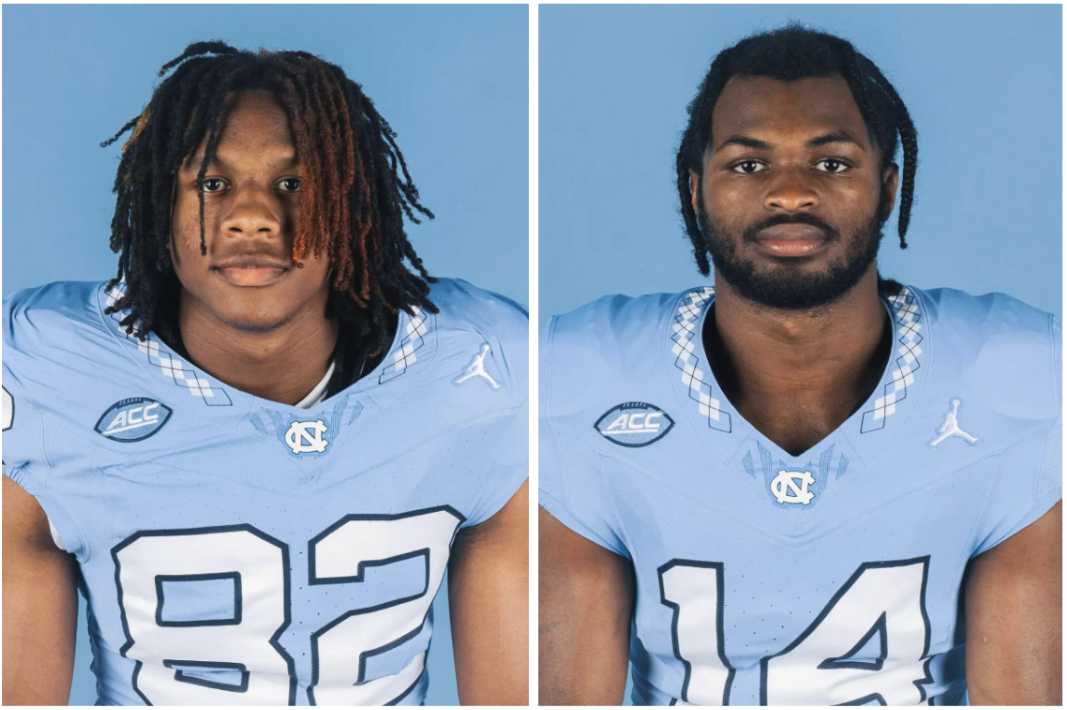
UNC freshmen receivers Keeyun Chapman (left) and CJ Sadler (right). Source: UNC Athletics: Sadler, Chapman.
The Bill Belichick era began with an 83-yard touchdown drive against TCU in 2025, in front of a sold-out Kenan Stadium. The Tar Heels lost 48-14 and have since struggled to find consistent footing amidst constant off-the-field drama. This season, the Tar Heels began 2-0, beating the Horned Frogs in Ireland and defeating East Tennessee State two weeks later. But as is common under Belichick, controversy loomed.
On September 15, 2026, two freshman receivers, CJ Sadler and Keeyun Chapman, were involved in a traffic stop in Chapel Hill. Sadler, in the Cadillac Escalade, was cited for driving at least 60 mph in a 35-mph zone. Chapman was charged with carrying a concealed handgun without a permit and possessing marijuana, according to a Chapel Hill police report. Police seized 15.1 grams of marijuana from the vehicle. Chapman was suspended indefinitely, and Sadler was forced to sit out the team’s third game against Clemson.
The incident raises questions that UNC-Chapel Hill has long resisted answering. In 2010, UNC asserted a federal privacy law to withhold records from the NCAA during an investigation of its football program, and a media coalition won a lawsuit against the university. When an athlete breaks the same rules as any other student, who decides the consequences—do they parallel one another? Despite student-athletes in the NIL era of college football mirroring professional athletes more closely than regular students, all university students are subject to the same code of conduct.
Under UNC’s code, students are strictly prohibited from possessing or using a controlled substance as defined by state or federal law. A first offense for marijuana possession carries a minimum penalty of probation, with violation of its terms resulting in automatic suspension. Further, the gun allegation likely falls under a catch-all violation covering any legal violation that harms community members or university interests. The Office of Student Conduct judges such occasions, and its outcomes are confidential under federal privacy law. The public can see discipline coming directly from coaches and the athletic director, conducted through a separate process.
Athletes charged with low-level felonies and misdemeanors may continue practicing at the athletic department’s discretion. In the past, that discretion has produced varying outcomes. In 2013, basketball player P. J. Hairston wasn’t suspended following a marijuana arrest in which police found a handgun near his car. Later that year, he was suspended indefinitely for driving 93 mph in a 65-mph zone. Chapman was suspended indefinitely within two days of his gun charge, while Sadler, cited for his third speeding offense since August, sat out against Clemson with no suspension announced.
Responses have also shifted from coach to coach. In 2024, three players were charged with misdemeanors tied to a car crash that killed UNC student Molly Rotunda. Mack Brown, former head coach, let the athletes take part in spring practice, and discipline would wait for further clarity from the court. Additionally, in 2025, WRAL conducted an investigation in which nearly 20 percent of the roster had been cited for speeding. UNC did not say whether any player had been disciplined. The inconsistency in consequences faced by student-athletes shows various punishments depending on the coach, timing, and player. This pattern invites scrutiny about the ethicality of inconsistent consequences.
Chapman’s suspension was announced in the same statement concluding a seven-week investigation into the program. General Manager Michael Lombardi resigned during the investigation, and defensive coordinator—and head coach’s son—Steve Belichick will step down when his medical leave ends in late October. The investigation focused on allegations about potential drug use by Steve Belichick, possible NCAA rules violations, and potential sexual relationships between players and staff members of the team. UNC said that Chapman’s suspension reflected “the University's commitment to accountability and the well-being of its student-athletes.”
After a 28-20 loss to Clemson, the Tar Heels return from a bye to host the nationally ranked third Notre Dame on Saturday, October 3. Off the field, the policy that governs decisions like Chapman’s and Sadler’s lists its last review as Spring 2020, according to UNC’s website. Its next review was due in July 2023. Currently, no confirmation of the review is publicly available.
Nearly two weeks after the initial announcement, the team has not updated either player’s status. When asked about Chapman’s availability for the Notre Dame game, Belichick said, “Yeah, we'll see.” Until UNC releases its internal policy, the athletic department must be accountable to the public for what it chooses to announce, each new incident having its own precedent.