
Pope Leo XIV Visits a Secular France
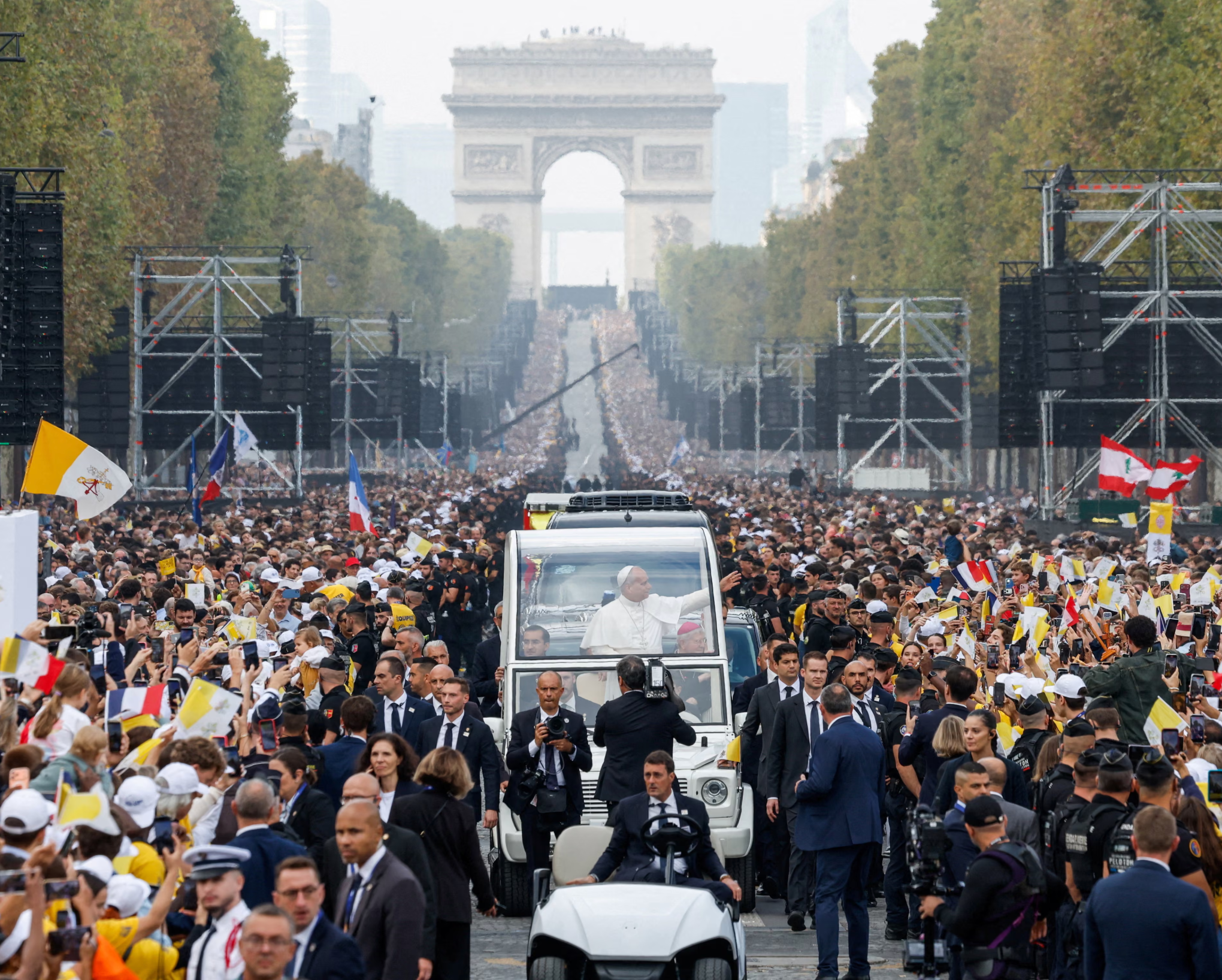
Pope Leo XIV waving to the crowd waiting for his arrival on the Champs-Élysées for his open-air Mass on September 26. Source: The Guardian.
Pope Leo XIV recently made a landmark four-day apostolic journey to France, his first as pontiff. He visited Paris, Lourdes, and Metz during his four-day tour from September 25-28. This trip marked a political and social balancing act between the Vatican’s ties to traditional Catholic strongholds and an increasingly secular European population. Under Article 1 of its constitution, France operates as an “indivisible, secular, democratic and social” republic. Laïcité, or secularism, is a vital principle for the French government, promoting political and cultural unity through strict state neutrality toward religion. Anticlerical sentiment has deep roots in France, dating back to the French Revolution in 1789; religiosity is now often considered to be a relic of the past.
Despite decades of declining Catholic adherence, recent studies point to a resurgence. During Easter 2026, 13,000 adults were baptized in France, coinciding with a point at which the annual baptisms within the nation have tripled over the past decade. Some have attributed this shift toward Catholicism to the rise of anxiety and depression amongst younger generations caused by major global events like the COVID-19 pandemic, wars, and climate change.
A further testament to France’s enduring Catholic presence was the crowd of 800,000 people who attended Pope Leo XIV’s open-air Mass in Paris on September 26. Throughout his trip, the Pope cautioned against the dangers of the new technological age and the need to preserve human dignity—themes he laid out in his first encyclical, Magnifica Humanitas, published earlier in May. Additionally, encouraging French Catholics to maintain their faith, he also urged European nations to embrace a culture of dialogue, calling on leaders to replace a “desire for domination” with negotiation. He specifically cited the Russo-Ukrainian war as an instance where such an approach is necessary to prevent further loss of life.
The Pope directly addresses an increasingly secularized Europe. Speaking to government officials, civil society leaders, and the diplomatic corps on September 25 at the Élysée Palace, the pontiff noted: “An authentic secularity, then, consists not in excluding religion from the public sphere or from education, but in striving to ensure that the state and religious institutions maintain dialogue and join forces in the service of the common good.”
This focus on shared interests as common ground illustrates how the Vatican is navigating church-state relations in the developed world. A similar strategy was evident with the Pope’s Apostolic Journey to Spain in June, where he addressed the Spanish Parliament and framed a pathway toward shared common good through collaboration with religious institutions.
President Macron navigated the visit cautiously. He said that the pontiff’s message would appeal “to the conscience of all French people.” He also said that laïcité is a system that is “in no way the negation of religion.” By casting laïcité as a protection of individual freedom rather than as a hostility towards faith, Macron could welcome the Pope without appearing to compromise the secular state.
Notably, Macron strategically posited support for secularism by not attending the Pope’s September 26 open-air Mass. There was no private meeting between President Macron and the Pope. Macron’s strategic separation of the state and religion demonstrates how diplomatic secularism still operates completely and cautiously separate from Catholicism.
French lawmakers had different reactions to the pontiff’s trip. Left-wing lawmakers criticized the secularist principles that were pushed against by the symbolism of having the Pope hold Mass at major national sites. Alexis Corbière, a Member of Parliament and part of the L'Après party, said, “Holding the year’s biggest religious celebration at the heart of the most symbolic axis of Republican power … It’s a move that demonstrates the place some would like religion to regain in the public sphere.” More support from the right-wing and centrist politicians. While no left-wing candidate attended the Pope’s open-air Mass, the right-wing prime minister, Sébastien Lecornu, and five presidential candidates did attend the Mass.
While political support was displayed, the character of the trip remained necessarily ceremonial, with no signed agreement, joint declaration, or formal joint initiative between the Holy See and France on political issues. Foundational political separation between secularism and Catholicism in French governance is still observed, and no substantive convergence was engendered by the Pope’s visit.