
Caught Between Moscow and Washington: India’s Energy Challenge
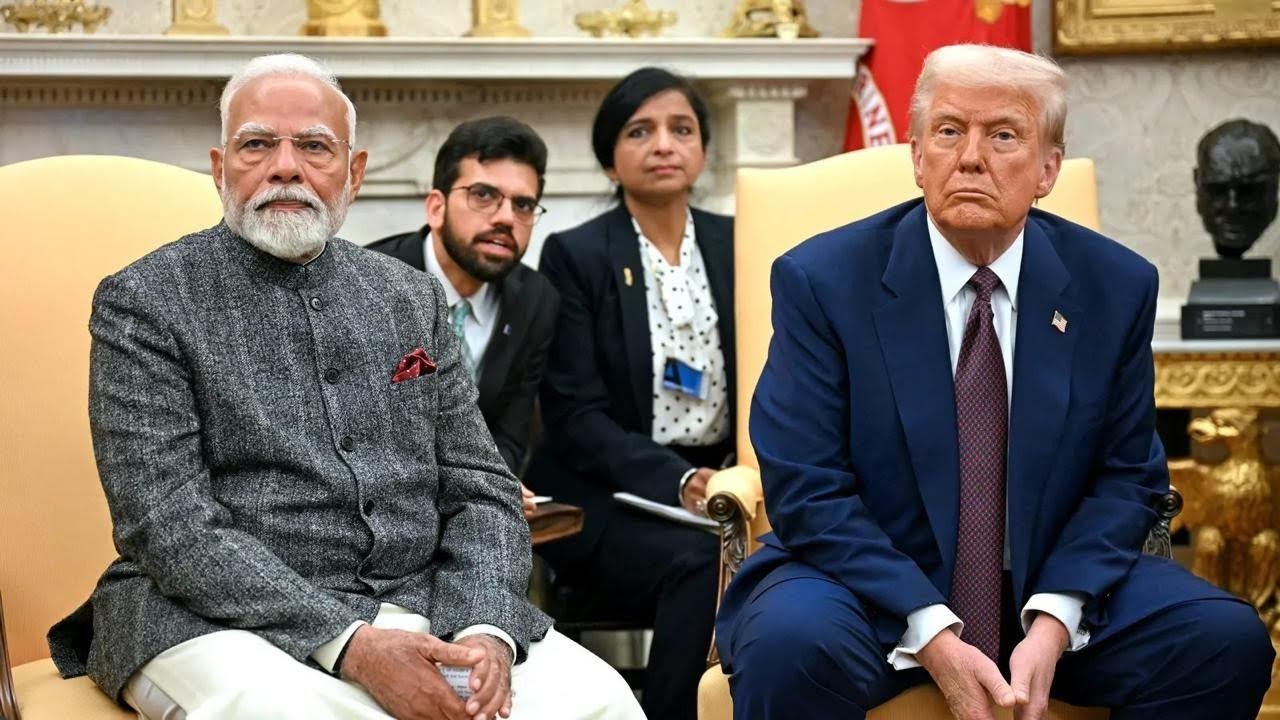
Prime Minister Narendra Modi speaks alongside President Donald Trump during their February 2025 meeting at the White House. Source: Bloomberg.
On September 18, President Donald Trump signed the Lindsey O. Graham Sanctioning Russia and Iran Act of 2026. Among other measures, the law allows the United States to impose tariffs on major importers of Russian oil and gas, thus putting renewed pressure on India amid concerns over energy affordability.
The latest measure follows a rapid shift in Washington’s approach. In August 2025, the administration imposed an additional 25 percent tariff on Indian goods in response to Russian oil imports before removing it in February 2026, claiming that New Delhi had committed to stop purchasing Russian oil. Although Washington presents the measure as a means of limiting Moscow’s trade profits amid its ongoing invasion of Ukraine, for India. The law became a trade-off between economic well-being and preserving its relationship with the United States.
For the United States, the policy prioritizes access to American markets as leverage against Russia’s wartime economy. The new law targets Russian officials, banking institutions, and, importantly, third countries that continue importing Russian natural resources.
The logic is straightforward: if Moscow loses its foreign buyers, it will have to offer discounts large enough to offset the risks of ongoing trade, reducing the revenue available to finance its military operations. The law also gives Trump a degree of bargaining power: the tariff can be raised to as much as 100 percent depending on a foreign government’s decision regarding purchases from Russia. In this way, the measure can not only punish a country for the purchases it already made, but also provide Washington with sway over its future purchases of Russian oil.
In response, New Delhi has warned that the legislation could significantly affect both U.S.-India relations and a growingly unstable global energy market. For a country that imports roughly 90 percent of the crude it consumes, with over 35.8 percent from Russia, any interruption of this supply would create substantial economic pressure. At the same time, the United States remains India’s most important trading partner: in 2025 alone, U.S. imports of Indian goods reached $103 billion, while total U.S.-India trade reached $239.6 billion. The February agreement already demonstrated how closely Russian oil had become tied to this commercial relationship: removing the additional 25 percent tariff, Washington reduced its reciprocal tariff on Indian goods from 25 to 18 percent.
Beyond trade, potentially deteriorating relations with the United States could also complicate India's technological and security priorities. Earlier this year, India announced plans to purchase roughly $500 billion in U.S. technology, aircraft, and other goods, while expanding collaboration in maritime security and cyberspace—areas progressively tied to its effort to counter China’s growing influence in the Indo-Pacific. The scale of these competing interests leaves India under strain from opposite directions, forcing it to weigh its energy needs against the strategic benefits of cooperation with Washington.
At the same time, India has recently faced disruptions in the international petroleum sector as its growing reliance on Russia coincided with instability along most major Middle Eastern supply routes. Before Russian crude played a central role in the nation’s fuel-sourcing approach, over half of India’s oil imports passed through the Strait of Hormuz. Meanwhile, Iraq, Saudi Arabia, and the UAE remained major oil sources for Indian refining. When the recent crisis made shipments through the Strait of Hormuz increasingly unreliable, New Delhi had to raise the share of hydrocarbons arriving through non-Hormuz channels from 55 to 70 percent. During the same disruption, Washington temporarily moved opposite its earlier pressure.
On March 5, the Treasury authorized Russian-origin oil already loaded onto vessels to be delivered and sold in India through April 4. Against this background, finding a substitute for Russian oil became more challenging, particularly after Western sanctions created substantial discounts on Russian crude. As Indian orders expanded, shipments from Russia generated estimated savings equivalent to 0.2 percent of India’s GDP. The dependence is also mutual: India now absorbs around 37 percent of Russian crude exports, second only to China at 50 percent, meaning that major declines in demand would leave Russia considerably more reliant on Beijing.
Thus, the United States’ attempt to constrain wartime revenues could paradoxically reinforce India’s incentive to preserve those energy flows as insurance against future supply shocks.
Today, India has to decide how much diplomatic maneuverability it is willing to sacrifice before its commercial options become increasingly constrained. If Gulf volatility persists while the rules of the sanctions game continue to shift, reducing exposure in one direction may quickly create vulnerability in another. Unless New Delhi finds a compromise that both diversifies its supplies and keeps Americans satisfied, each additional constraint could leave it negotiating from a weaker position than before.