
When Loyalty Fails: Zhang Youxia and Xi’s New Military Order
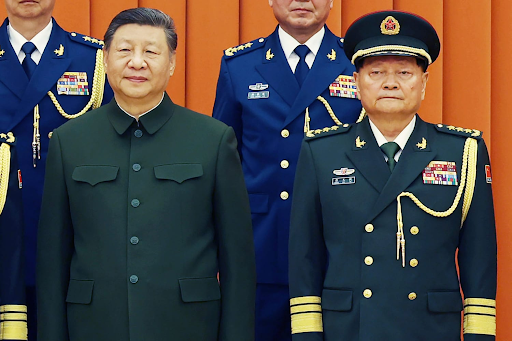
President Xi Jinping (left) and General Zhang Youxia (right) in Beijing in 2025. Source: NBC News.
Zhang Youxia, the People’s Liberation Army’s (PLA) second-highest ranking officer, under investigation for “serious violations of discipline and law.” Both Chinese and foreign media reported that Zhang was suspected of leaking sensitive nuclear weapons information to the United States and accepting bribes. Fellow Central Military Commission (CMC) General Liu Zhenli is also implicated in this investigation. This move is widely seen as the most drastic move yet on President Xi’s part.
As a combat veteran of the 1979 Sino-Vietnamese war and the Battle of Laoshan in 1984, General Zhang is one of the few serving generals in China with war experience. He co-chairs the CMC alongside Xi, overseeing the PLA Rocket Force and nuclear arsenal. In China’s system, public investigations of this kind rarely end in acquittal, making Zhang’s likely removal a signal of Xi’s intolerance for even perceived disloyalty.
This case is the latest in a sweeping purge that began back in 2023 that targeted dozens of senior officers across the CMC, PLA, Ministry of National Defense, and People’s Armed Police as part of a broader restructuring of the military to centralize control under Xi and enforce ideological conformity. Analysts have said that Xi’s purge has made him increasingly powerful yet isolated: he has shown that he can remove almost any senior officer at will, but also has thinned out the circle of experienced commanders willing to offer candid assessments or counter his preferences. Reports shared that Xi has replaced top generals with younger officers whose main credentials are party loyalty and a willingness to implement Xi’s policies.
All of this comes at a time when Beijing is increasing pressure on Taiwan. Experts have expressed worries about removing experienced commanders precisely when confrontation is on the horizon. But focusing solely on the operational risks misses the deeper point: the investigation into Zhang is less about alleged misconduct and more about the politics behind it.
Since taking power in 2012, Xi Jinping has treated the PLA as a key political instrument with unwavering loyalty to keep him in power. His anti-corruption campaign has carried the dual purpose of cleaning up and removing potential rivals. The current purge of military commanders is an extension of this effort. By targeting figures at the very top, Xi reinforces the message that no rank is protected.
There are three reasons why this campaign has intensified now. First, Xi appears determined to eliminate those who have accumulated too much alternative authority in the armed forces. Senior generals in China historically built influence through shared service, combat credentials, or long-standing factional ties. Zhang’s battlefield experience and stature in the CMC gave him institutional weight that was independent of Xi. In a system where power is personalized, respected military prestige is perceived as a political risk. Removing these figures reduces the likelihood of dissent during a crisis.
Second, Xi is preparing the PLA for a period of tension and conflict. Beijing’s more frequent and sophisticated military pressure on Taiwan, as well as its competition with the United States, has deepened across multiple domains ranging from cyberspace to the South China Sea. Xi’s priority is not just capability but, more importantly, control. Should a confrontation occur, Xi requires absolute confidence that orders would be carried out precisely as intended.
Third, the line between national security and political security is thin in China. Over the past few years, China has rapidly expanded its missile and nuclear forces. Allegations of senior officials mishandling sensitive information strike at the heart of the regime’s security. For Xi, tightening oversight over the Rocket Force and other branches is as much about military reform as it is about safeguarding the regime.
Why is this so important now? The reason is that China now stands at an inflection point. With slower economic growth, a tense U.S-China rivalry, and the unresolved nature of Taiwan, Xi’s decision highlights that the current threat is a result of internal fragmentation—not external. By asserting control over the military, he ensures that the Party will follow him should China move toward conflict.
The investigation into Zhang reveals the broader transformation of Xi reshaping the political landscape around personal authority and ideological conformity. What remains clear is Xi’s determination to consolidate power before the moment slips—and he will not waste it.