
UNC Plans to Close Its Six Study Centers Amid Federal Funding Cuts
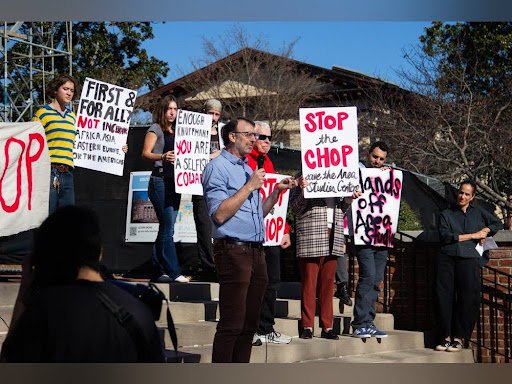
Credit: June Brewer, UNC history professor Dr. Chad Bryant speaks at a protest against UNC's decision to cut six area research centers outside the South Building on Wednesday, Jan. 7, 2026.
Speaking at the Press Conference “Stop the Chop” by the TransParUNCY, Allison Reilly, a soon to be a Graduate from the Global Studies program, a double Tar Heel, raised her voice along with other speakers and said, “My heart breaks for the harm proposed by the university’s decision to close the study centers. These harms impact individuals, students, faculty, research, and livelihoods are being swept away without consultation or warning.”
Last December, the Daily Tar Heel reported that UNC plans to close 14 of its research centers and institutions to save money, given financial deadlocks at the federal level, which can cause financial anxieties across the country within the education sector. The recent reports point out that the Federal Legislators continue to support education investment, despite cuts proposed by the current administration.
The proposed closure of study centers has mobilized both students and faculty members to participate in student discussions, presentations, press conferences, and lobbying to defend the study centers.
On January 20, another student gathering was organized by TransparUNCY at the UNC student stores, which was well attended. The organizers shared their opinions, remarking that the recent proposal for the studies is politically motivated rather than financial, given the vast financial resources available to the university. During the presentation, speakers argued that the University has enough financial means to run the study centers without any issue. Based on the data presented on the day, speakers said that UNC's unrestricted net assets range from $1,134,861 in 2020 to $1,990,611 in 2025.
Nate Knuffman, the Vice-Chancellor for Finance and Operations, told the Board of Trustees in a November meeting that the University plans to close 14 centers and institutes, which would reduce spending by $7 million over several years. These cuts are part of the wider operations being closed, which would save $70 million, according to published reports.
The organizers from the TransparUNCY argue that, given the financial health of UNC, saving $7 million does not make any financial sense, given the impact of such closure for the students and teachers alike, as well as the reputational and global risk to the university.
The speakers also argued that decisions to close centers were unilaterally made by university management without the views of students and teachers. One speaker said, “Public universities are not private corporations, and students aren’t consumers.”
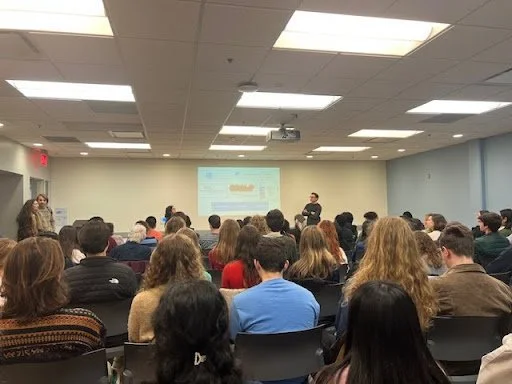
Meeting at the UNC Student Store on 20th January, 2026 - Photo Shahid S. Khan
The speakers at the event argued that such a decision is more technocratic, top-down, and based on neo-liberal policies; these market-measures for public education take away the privilege of students to learn, connect, and grow together as a community within the university space.
The Office of the Faculty Governance issued a statement on January 21, which noted that the university’s Board of Trustees, which is a decision-making body on this issue, decided not to vote on the Studies Center at their meetings on January 21 and 22. The statement also appreciated the outpouring of support from students and faculty alike through various modes of communication, discussion points, and included more than 400 pages of letters of support.
A letter issued and signed by the faculty of the Curriculum in Global Studies (seen by the author) on December 19 to the Chancellor, outlined the impact and global reach of the area studies centers. The letter urged the UNC decision-making body to reconsider the decision.
The letter seen by the author provides evidence on the impact of the centers on the wider learning ecosystem and notes how the Curriculum in Global Studies has benefited from the centers over the years. It states that, “our (the Curriculum in Global Studies) undergraduate and graduate curricula have benefited tremendously from the programming, professional development, and outreach events offered by the Centers.”
Furthermore, the letter notes how exposure to diverse cultural learning and “activities deepen classroom learning, gives students opportunities to meet experts and practitioners, and brings community members to campus to engage with students and faculty. They are often the catalyst for students’ interest in study abroad and provide a “home” for students when they return, fostering a truly globally engaged campus.”
The letter also noted that the decision to close the centers will be a ‘tremendous loss’ for students and faculty, as the centers are “essential to UNC’s academic excellence, global reputation, and commitment to serving the state of North Carolina.”
The university acknowledged the letter and said that they will consider the information in their decision-making, based on sources closer to this topic.
Laura Dawn, a PhD in African studies and an alumnus of the African Studies Center, told me the impact the African Studies Center had on her life since 2018 and the precarity of life she is living. She said, “I might lose my job if the African Center is shut down.” See the full video, which provides reflections from Laura Dawn, Outreach Manager in the African Studies Center, and Chad Bryant, Professor of History and adjunct in the Curriculum in Global Studies, on the proposed closures.
These studies centers include Center for Middle East and Islamic Studies, first opened in (2003), Center for Salvic, Eurasian and East European Studies (1991), Institute for the Study of the Americas (1940), the African Studies Center (2005), and the Center for European Studies (1994) as well as the Carolina Asia Center (2002).
The study centers have been part of the University’s research approach that provided a deeper understanding of the regions from around the world. Based on the Studies Center website, it notes that “the centers provide resources and services for learning and research linked to global issues, world regions and modern foreign languages.” This also demonstrates the importance of providing global understanding to students through study centers that can solve solutions at the global level. Knowing different regions, cultures, and languages is part of the learning process.
These centers have been serving the Carolina community since the 1990s and 2000s for more than a decade, serving thousands of students (past and present) from around the world. All centers have been engaged in learning and developing an understanding of these regions through seminars, public lectures, and grants and scholarships.
The full closure of these centers means that students and faculty could lose their community and opportunity to learn about a specific religion in the world. UNC Global Guarantee promises that “every student has access to a meaningful and comprehensive global education.”
Allison Reilly said, “You simply cannot meet that promise while cutting the very institutions - and people - that make global promises a reality.”
It is important to see how many students and teachers have come forward to express their views and solidarity against the decisions made at the high level without any engagement with those who are mostly impacted by them.
It is time for the university to make decisions with the people, rather than for people.