
The Ethos Guiding Trump’s Foreign Policy in His Second Term
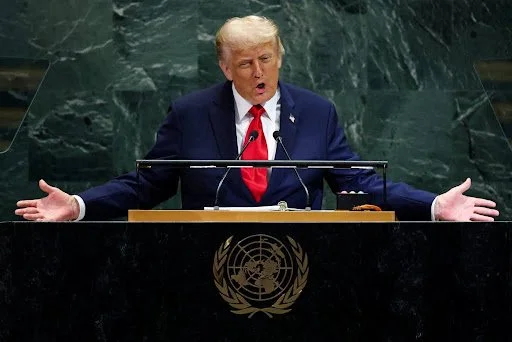
President Trump speaking at the United Nations in September. Source: PBS
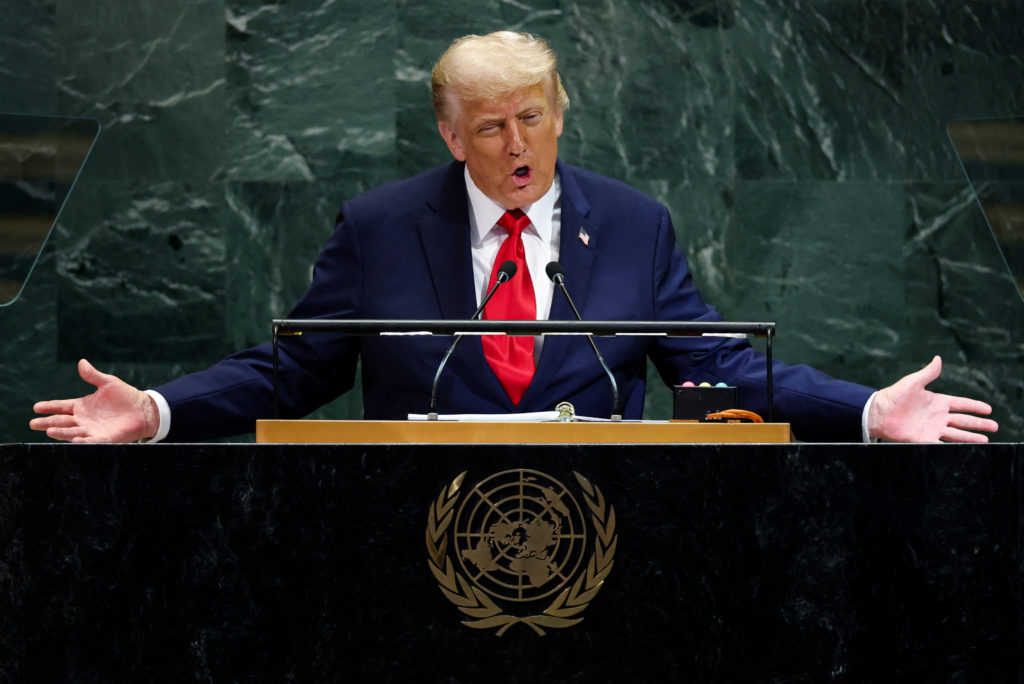
In November 2025, the Trump administration released its National Security Strategy, which outlined an ambitious vision of American power both overseas and at home. The 33-page document is filled with Trump’s familiar rhetoric about stopping mass migration and bolstering American strength. It describes Trump’s foreign policy as “pragmatic without being ‘pragmatist,’ realistic without being ‘realist,’ principled without being ‘idealistic,’ muscular without being ‘hawkish,’ and restrained without being ‘dovish.’” In summary, it puts America First.” In practice, however, Trump’s policy doesn’t meet this standard. Trump’s foreign policy decisions do not seem to be motivated by genuine national security interests.
Greenland is a prime example. Trump’s justification for annexing the island is “strategic national security and international security,” specifically protection against adversaries like Russia and China, who have been active in the Arctic region. Yet neither Russia nor China has attempted to encroach on Greenland’s sovereignty. If Trump truly perceived such an urgent threat, there are several other channels that he could take to strengthen the US’s presence in the Arctic. For example, a Cold War-era agreement gives him the power to expand the US’s military presence in the territory almost at will. Instead, he has pressured Denmark to hand over full control of the island, despite Denmark having sovereignty over it for centuries. Strong-arming allies and straining the cohesion of NATO, the very alliance created to deter threats from Russia, seems to run directly counter to Trump’s goal of deterring Russian aggression.
Another national security concern raised by the Trump administration was the inflow of drugs from Latin America. Their solution was to conduct strikes on boats in the Caribbean that were believed to be smuggling substances like fentanyl from Venezuela into the United States. Yet independent analysts have found that the vast majority of fentanyl comes from countries like Mexico and China, and United Nations reports show that it plays a minor role in the trafficking of other illicit drugs like cocaine compared to other states in the region. At the same time, Trump pardoned former Honduran President Juan Orlando Hernández, who was convicted of trafficking cocaine into the United States.
Given the disconnect between Trump’s purported national security goals in Greenland and the Caribbean, and the actions he has actually taken to achieve them, it is reasonable to question whether there is some other force driving his foreign policy decisions, outside genuine national security concerns. His rhetoric suggests that his foreign policy motivations are often personal and appear to be shaped primarily by his own judgment.
When it comes to addressing national security threats, Trump seems to view himself as operating above, rather than within, the frameworks of the international institutions that constrained and, at times, embarrassed him during his first term. When asked by the New York Times if there were any limits on his powers, he said, “My own morality. My own mind. It’s the only thing that can stop me.” He said, “I don’t need international law. I’m not looking to hurt anybody.” These responses could offer insight into Trump’s perception of his own power and demonstrate that his foreign policy decisions can be guided primarily by his personal will and judgment, rather than traditional diplomatic frameworks.
Trump seems to view diplomatic rejections as personal insults. His reaction to not winning the Nobel Peace Prize offers a telling example. In a letter to the president of Norway, despite the fact that the Norwegian government does not choose Nobel laureates, Trump said, “Considering your country decided not to give me the Nobel Peace Prize…I no longer feel an obligation to think purely of Peace [sic]…The World is not secure unless we have Complete and Total Control of Greenland.” Rather than grounding foreign policy in diplomacy or strategic doctrine, Trump is allowing his individual ego to directly influence his actions and strain relationships with longstanding allies.
Trump’s push for full ownership of Greenland rather than taking other routes to strengthen national security, like the aforementioned Cold War treaty, may stem from his background as a former businessman and real-estate developer. As in real estate, what appears to matter is not strategic advantage itself, but rather the symbolism and benefits of ownership. When asked in a New York Times interview about why he wanted American ownership of Greenland rather than just fortifying US military presence there, he said “ownership gives you things and elements that you can’t get from just signing a document,” and that full ownership of the island was “psychologically important for [him].”
There is a darker possibility that Trump’s motivations may run deeper than just personal psychology. He is often praised for running the government like a business. But if the American government is a business under Trump, it looks most like the Trump Organization—built to enrich himself and his inner circle. There are conflicts of interest everywhere: foreign leaders showering glitzy gifts or pouring money into his crypto schemes in exchange for favorable policies, and funneling millions of dollars from Venezuelan oil straight into the pockets of his billionaire donors, just to name a few examples. With any other president, this brazen conflict of interest could become a major scandal. With Trump, however, self-enrichment using the highest office in the land seems to be the norm, not a flaw.
The closest historical parallel would be the administration of President Warren G. Harding. His administration was rocked by the Teapot Dome Scandal, in which Harding’s interior secretary, Albert B. Fall, secretly leased federal oil reserves to oil companies in exchange for bribes. Yet Harding, unlike Trump, was widely seen as inattentive and overly trusting, not personally orchestrating the corruption unfolding around him. In addition, Fall received a year-long prison sentence due to the scandal. No one yet seems willing or able to hold Trump accountable for his abuse of power.
Great powers don’t decline overnight. They erode gradually from the concentration of power in the hands of one or a few, and the normalization of behavior from the leaders that previously would have been disqualifying. Responsible citizens must not accept a reality where a country’s safety, reputation, and morality can be trumped by the ego and private interests of the President.