
Counting the Costs of Stricter Voter ID Laws
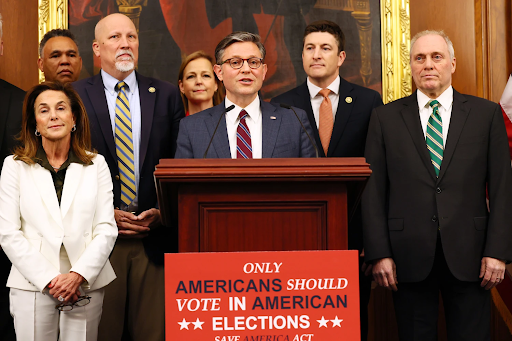
Speaker Mike Johnson during a press conference about the passage of the SAVE America Act at the Capitol building. Source: Michael M. Santiago / Getty Images.
In February 2026, the U.S. House of Representatives passed the Safeguard American Voter Eligibility Act, now known as the SAVE America Act, with support from every Republican and a single Democrat, Representative Henry Cuellar of Texas. It would require all voters to show government-issued photo ID, imposing stricter verification measures to prevent what its supporters call fraud. The bill originated from a 2024 initiative led by Donald Trump and Speaker of the House Mike Johnson to stop noncitizens from voting in U.S. elections. Still, in May 2024, Mike Johnson and allies of Donald Trump held an event promoting the need for the SAVE Act’s protections against noncitizen voting. Several attendees had previously tried to assist Trump in overturning the results of the 2020 United States presidential election.
President Trump, on Truth Social, said, “There will be Voter I.D. for the Midterm Elections, whether approved by Congress or not!” He also said that he has “searched the depths” of legal arguments on the issue and plans to present what he called an “irrefutable” case soon, though he did not specify further. However, the proposed legislation may be brushing over an array of broader issues, according to a recent report from the nonpartisan Center for Election Innovation and Research. This claim that noncitizens are voting often results from errors, misleading interpretations, or completely false information about voter records. The act faces significant obstacles in the GOP-controlled Senate due to Democratic opposition and the 60-vote requirement needed to overcome a filibuster. While some Republicans have suggested bypassing the filibuster to push the bill through, party leaders have shown little enthusiasm for that approach.
Individuals who are less likely to possess government-issued identification are often lower-income, a group that frequently includes communities of color. A study of voter ID laws in Kansas and Tennessee found that younger voters and Black residents, groups that tend to lean Democratic, were disproportionately impacted, resulting in over 100,000 fewer votes than expected. More than half of registered voters (52%) do not hold a valid passport in their current legal name, and around 11% of registered voters cannot easily access their birth certificate.
Voting in federal elections is already illegal for non-U.S. citizens, and documented cases of voter fraud, including by noncitizens, are extremely rare. In addition, about 36 states already require voters to present some form of ID at the polls, with some specifically demanding a photo ID while others accept alternatives like a bank statement. The Heritage Foundation’s “Election Fraud” database, a resource often used to suggest that voter fraud is widespread and a serious issue, records only 34 instances of in-person voter impersonation during a time when roughly 1.5 billion votes were cast in federal elections.
The U.S. Constitution does not itself require voters to be citizens. Protections against discrimination in voting (based on race, sex, or age) were added later through amendments from the post–Civil War era through the 1970s. By design, the Constitution leaves states responsible for setting voter eligibility under the 10th Amendment. An August 2025 survey from the Pew Research Center reported that 83% of Americans support a requirement for voters to show photo ID. Republican Senator John Thune said this broad public backing is one of the main reasons Republicans are pushing for a vote on the bill, even though it may not secure the 60 votes necessary to break a filibuster. However, the potential changes of this overstep may bring more harm than good to the polls.
The SAVE America Act would overhaul voter registration at every stage, requiring costly, time-consuming changes. Despite these challenges, the law would take effect immediately upon enactment, giving states no time to adjust. It could also put election workers in a difficult position, exposing them to both legal and personal consequences. The bill would criminally penalize officials who register someone without the required proof of citizenship, even if that individual is actually a U.S. citizen. As a result, officials might potentially turn away valid applications if they are unsure about the documents, which could worsen the challenges facing an already overburdened and understaffed election workforce. While supporters frame the SAVE America Act as a safeguard against voter fraud, critics warn it risks disenfranchising eligible voters and overburdening election systems, leaving the nation to weigh procedure against accessibility at the ballot box.