
Pam Bondi Takes to the Stand: Political Theater and the Lack of Accountability in American Democracy
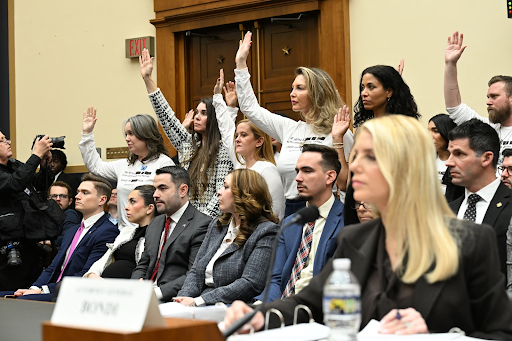
Bondi at the House Judiciary Committee hearing on February 11, with Epstein survivors standing behind her. Source: ABC News.
On February 11, U.S. Attorney General Pamela Bondi testified before the House Judiciary Committee regarding the handling and heavy redaction of the Epstein Files. Her behavior was the subject of intense scrutiny, as she responded combatively to questions and acted excessively protective of President Trump. Bondi’s behavior has placed her outside the realm of a respectable and legitimate public servant, especially for the nation’s chief law enforcement officer.
The hearing was characterized by contentious exchanges between Bondi and various House representatives. Bondi repeatedly deflected numerous questions about the lack of transparency regarding the release of the Epstein documents. Bondi and Representative Jamie Raskin (MD-8) had a particularly heated exchange, where Raskin became visibly frustrated at Bondi’s lack of understanding of House rules. When he directly asked her if she would create a Justice Department task force to investigate the crimes committed against Epstein’s victims, she circumvented the question to talk about an unrelated topic in an attempt to bash Raskin’s competency. Similarly, when questioned by Representative Jerrold Nadler (NY-12), Bondi quickly redirected to economic achievements under Trump, such as the Dow Jones stock increasing since he had been in office.
Representative Pramila Jayapal (WA-7), among others, called for a personal apology from Bondi to the numerous Epstein victims who were present at the hearing. The victims sat behind Bondi throughout the hearing, wearing white t-shirts in solidarity, eager to make their voices heard. Despite lawmakers’ numerous reiterations that the victims had been continuously denied a chance to meet with the Justice Department to express their concerns, she refused to acknowledge them. This blatant disregard for the individuals who have been exploited, both physically and psychologically, further serves to depict Bondi as a politician who only seems to care about justice when it advances her personal interests.
As an individual in one of the highest tiers of legal authority, the American public deserves better. Her attempts to evade responsibility, with full support from President Trump, sends the message that the justice system at present does not truly work for the people.
As expected, her refusal to answer questions and remain committed to the subject at hand drew heavy backlash on both sides of the aisle, resulting in intensified demands for her impeachment. Bondi’s efforts to shield the names of those who engaged in these crimes, while simultaneously releasing personally identifiable information of victims without their consent, clearly violate the provisions of the Epstein Files Transparency Act signed into law on November 19. Her conduct makes clear she will go to extensive lengths to protect Trump from embarrassment or potential criminal implication, even calling him the greatest president in the nation’s history during the hearing.
Bondi has long been a member of Trump’s inner circle, as she served on his legal defense team during his 2020 impeachment trial. Additionally, in 2013, the Trump Foundation made a $25,000 donation to Bondi’s reelection campaign for Florida Attorney General, which was later found to be an illegal contribution. Bondi was also heavily involved with the conservative think tank America First Policy Institute, which is spearheaded by past and current members of the Trump administration.
One of the core values of the Department of Justice is independence and impartiality. Part of the agency’s mission statement states, “We work each day to earn the public’s trust by following the facts and the law wherever they may lead, without prejudice or improper influence.” However, Bondi has no intention of upholding this promise.
The role of the Attorney General has been one characterized by fairness and bipartisan accountability, not one-sided allegiance. The idea that no one is above the rule of law, not even the president, was demonstrated in 1973 when President Richard Nixon ordered the firing of a prosecutor who was actively investigating the Watergate scandal. This became infamously known as the Saturday Night Massacre, and Nixon’s attempts to obstruct a federal investigation led to widespread political outrage. The House Judiciary Committee ultimately approved articles of impeachment against him for obstruction of justice, abuse of power, and a refusal to comply with Congress. This intense pressure led to his ultimate resignation, showing that accountability structures in the highest tiers of government can prevail in the face of a corrupt administration.
However, today those accountability structures seem far weaker. Bondi’s refusal to resign in the face of impeachment threats, as well as her unending loyalty to Trump, sets a dangerous precedent that reputation takes priority over the protection and dignity of the American people.
All things considered, demands for Bondi to resign from her position are more than reasonable. Her heavy abuses of power and selective applications of justice can actively undermine legal accountability. What is at stake is not only whether Bondi will step down, but whether institutions that place justice over partisan loyalty will remain intact in the United States as a whole.