
El Mencho’s Death is a Tactical Victory, Not the End of Cartels
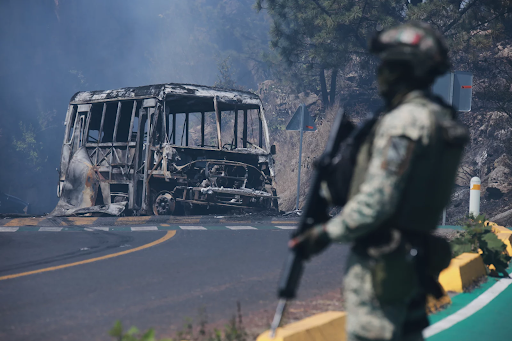
A soldier stands by a charred vehicle, set on fire following the death of Jalisco New Generation Cartel leader, El Mencho. Source: NPR.
On February 22, the Mexican army carried out an operation resulting in the death of Nemesio Rubén Oseguera Cervantes (“El Mencho”), notorious leader of the Jalisco New Generation Cartel (CJNG). On the surface, this marks a significant victory for the Mexican government in its battle against cartel power. For years, the CJNG has been one of the most dominant and violent criminal organizations in Mexico, known to be heavily involved in trafficking synthetic drugs, particularly fentanyl and methamphetamine, into the United States and Canada.
However, the immediate aftermath, along with the historical pattern of similar “kingpin” operations, suggests that long-term change remains uncertain. In response to El Mencho’s death, the CJNG have set up roadblocks and vehicle burnings across Jalisco, and tourist hubs such as Puerto Vallarta, in order to display strength and assert dominance over the region. This has temporarily disrupted travel, commerce, and effectively instilled fear in citizens.
The CJNG emerged around 2010 after splintering from the Milenio Cartel, a prominent cartel in Jalisco in the 2000s known primarily for trafficking cocaine, and it quickly distinguished itself through extreme, highly coordinated violence. Its tactics, public displays of force, armored convoys, and organized urban assaults resembling military operations set it apart from many rival groups and helped it consolidate territory rapidly. At the same time, the CJNG strategically pivoted toward synthetic drugs. Unlike cocaine or heroin, methamphetamine and fentanyl can be produced at cheaper rates, dramatically reducing production costs and expanding profit margins. The high return on relatively low input allowed CJNG to expand quickly, fund its militarized operations, and dominate trafficking corridors.
The U.S. Department of State has designated CJNG as a Foreign Terrorist Organization, making it illegal for American individuals or entities to knowingly provide the cartel with financial support, material assistance, or other resources, reflecting the severity with which the United States views the cartel’s activities. The strong response from the United States is unsurprising given the cartel’s connection to the ongoing opioid and synthetic drug crisis. Agencies such as the Drug Enforcement Administration (DEA) have long targeted CJNG leadership through indictments, sanctions, and intelligence cooperation with Mexican authorities. Canada has also increasingly become involved in addressing the cartel’s influence. As fentanyl and other synthetic drugs spread through Canadian cities, authorities have strengthened cooperation with both the United States and Mexico to combat trafficking networks.
The operation against El Mencho was carried out following increased pressure from the United States. Coordinated efforts between Mexico and the United States are likely to become more common, as President Trump has vowed to crack down on the flow of drugs and strengthen border protection. However, the ongoing retaliations by remaining members of the CJNG in Puerto Vallarta instill fear among tourists and residents and serve as a reminder of the cartel’s undeniable power. As a result, several commercial airlines, most notably Air Canada, temporarily suspended flights to the Puerto Vallarta area, and ultimately resumed service by Tuesday February 24. These events have dissuaded many possible tourists which could result in massive economic loss for Puerto Vallarta, as its economy relies primarily on tourism.
The true long-term effects of this operation are still unclear. Similar tactics, targeting and eliminating primary cartel leaders, have been used before, but they have done little to significantly reduce cartel activity. It is possible that with a renewed surge of international support, efforts against cartel activity could become more effective and long-lasting. Still, regardless of increased funding and intelligence collaboration, a larger question remains: can cartels truly be dismantled if the systemic issues that sustain them continue to persist? The death of a single cartel leader will not reduce the North American demand for drugs, and the million-dollar market will outlive El Mencho. If the CJNG weakens, another organization will likely step in to fill the gap, tapping into the same market and profiting from a crisis that both the United States and Canada have struggled to meaningfully curb. Moreover, the steady stream of cross-border gun trafficking, known as the “Iron River,” enables groups like the CJNG to obtain military-grade firearms, increasing their capacity for violence and making them far more difficult to suppress through military pressure alone.
Nonetheless, El Mencho’s death is significant, and targeting powerhouse cartels such as the CJNG can help decrease violence and crime throughout Mexico. However, it remains unclear whether successful collaboration between the United States, Mexico, and Canada will persist. Military action alone cannot resolve the issue; meaningful systemic reforms must also occur to truly make a dent in the market that sustains cartel power. The next steps of the Jalisco New Generation Cartel will be closely monitored, and so far it appears that the group is only more emboldened than ever.