
Setting the Narrative of the Deaths of Alex Pretti and Renee Nicole Good
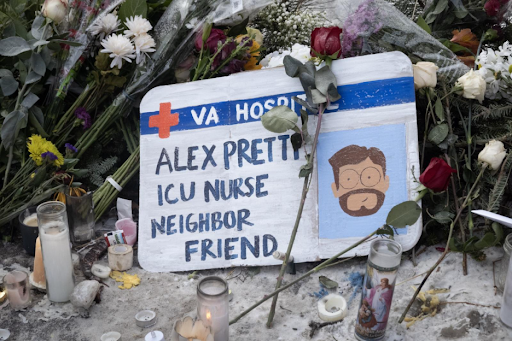
Handmade sign and other objects to memorialize Alex Pretti. Source: Truthout.
On January 24, 2026, mere weeks after the killing of Renee Nicole Good, Department of Homeland Security (DHS) agents fatally shot Alex Pretti while he was protesting the Trump administration’s efforts to crack down on immigration in Minnesota. Prior to his death, Pretti worked as an ICU nurse in Minneapolis and had consistently protested certain actions of the President, such as his revocation of several environmental regulations. Pretti’s interaction with the officers was recorded by an observer at the scene, who documented his attempts to protect a woman from a DHS agent before being shot multiple times. After the footage was released, President Trump labeled Pretti as a “domestic terrorist,” with various officials in his administration, such as Secretary of Homeland Security Kristi Noem and White House Deputy Chief of Staff Stephen Miller following suit. Though he was subsequently demoted from his position as Border Patrol “commander at large,” Greg Bovino commented, “This looks like a situation where an individual wanted to do maximum damage and massacre law enforcement.”
Following Pretti’s murder, U.S. District Judge Eric Tostrud, who was appointed by Trump, imposed a restraining order commanding DHS not to handle evidence from the scene of the killing. On February 2, he repealed this decision following concerns from several local and state officials that DHS would not adequately preserve evidence from the scene, allowing the Department to handle their investigation how they see fit. In his ruling, Tostrud wrote, “...the greater weight of the evidence shows Defendants are not likely to destroy or improperly alter evidence related to Mr. Pretti’s shooting during the life of this case.” Following Noem and Miller’s comments regarding Pretti echoing that of the President, the judge stated that they were blinded by partisanship in the face of relying on logic. Regarding the investigation, Tricia McLaughlin, Homeland Security spokesperson, argued that the Tostrud overstepped his authority and that the overturning of his previous ruling is an attempt to “save face.”
As of February 2, the Hennepin County medical examiner officially ruled the deaths of Pretti and Good as homicide by the hands of “law enforcement officers.” To differentiate, the coroner’s ruling of homicide simply means Pretti and Good’s deaths were caused by another individual. Despite the examiner’s ruling not indicating murder, defined by the DOJ as “the unlawful killing of a human being with malice,” a homicide ruling is likely to force an investigation to determine if the killing was justified. Prior to the ruling, Assistant Attorney General Todd Blanche announced that the Department of Justice has opened a civil rights investigation into Pretti’s death. The officers have been identified by ProPublica, an investigative news source, as Jesus Ochoa and Raymundo Gutierrez, despite Homeland Security claiming they have not identified those responsible for Pretti’s death. The FBI, Homeland Security Investigations, and Customs and Border Protection are each conducting some form of investigation into the matter.
Facing backlash for the murders of Pretti and Good, DHS has been forced to implement certain policy changes among its agents. After a few days, Noem backtracked on her claims of labeling Pretti as a “domestic terrorist” and insisted that it was because authorities had limited information to reference, all while stating DHS will “do better.” Similarly, Miller admitted that there is a chance the involved DHS agents were not following protocol. On February 2, Noem announced that DHS officers would, at some point, be required to wear body cameras. Following Noem’s pledge, Congress has provided DHS a two-week funding extension in order to consider new policy changes, such as body cameras. However, a consistent pattern among the second Trump administration is the clearing of federal agents’ actions, as exemplified by the killing of Good last month.
The homicides of Renee Nicole Good and Alex Pretti represent a larger trend in which federal agents murder American citizens and then attempt to manipulate public narratives. The rash labeling of Pretti as a “domestic terrorist” and the forced reversal of a court order that limited DHS’ supervision of evidence reveal how government institutions attempt to influence the story, even when the facts are not fully confirmed. Only after the public backlash did these agencies take a step back and promise policy reforms. As the investigations continue, the focus shifts from whether the killings were justified to whether institutions can impartially investigate themselves once their officials have attempted to sway public perceptions.