
The Strait That Shook the World
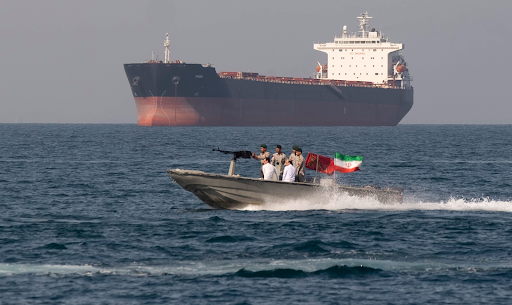
Iranian attack vessel patrolling the Strait of Hormuz. Source: CNBC.
Roughly 34% of the world’s oil and liquefied natural gas passed through a narrow strait linking the Persian coast to the Gulf of Oman and Arabian Sea. This waterway, the Strait of Hormuz, which averages a shipping capacity of over 20 million barrels of oil per day, has recently been caught in the center of conflict between the United States, Israel, and Iran. Since U.S. military attacks against Iran began on February 28th, Iran has effectively shut down this vital shipping route by attacking tankers with drones and missiles. As a result, crude oil prices around the world ballooned from around $70 a barrel to over $100 in the span of days.
Compounding this market damage has been Iran’s attack on nearby Gulf countries, specifically their energy production infrastructure, which has caused a halt in production in areas like Qatar. Kuwait, one of the top 10 oil producers in the world, was also forced to cease production in the days following the Iranian attacks on tankers due to a lack of storage space for excess oil that can no longer be shipped out. Large-scale maritime insurers like Lloyd’s of London have responded to the intensified conflict by expanding “high-risk” designations across the Persian Gulf, Gulf of Oman, and adjacent waters, which has led to mass cancellations of war-risk policies and dramatic spikes in premium prices, effectively worsening the market’s paralysis.
The cost of a spike in oil prices is not just paid for by consumers at the pump, since high energy prices create a ripple effect in nearly every industry, including shipping, aviation, fertilizer production, and manufacturing. The International Monetary Fund (IMF) warned on March 19th of the inflationary risk visible in the United States, with oil prices jumping over 14% in just a week, a greater spike than what was seen after the Russian invasion of Ukraine in 2022.
Moreover, with U.S. midterm elections around the corner, the ongoing increase in gas prices has created a political vulnerability for Republicans and President Donald Trump, who ran in 2024 on a platform heavily endorsing lowering inflation and increasing affordability. The irony is that the country most politically exposed to voter anger over gas prices is also among the least economically exposed to the blockade itself
The United States is not nearly as vulnerable to the blockade as Asia. 84% of the crude oil that passes through the strait is destined for markets in China, India, and South Korea, among other Asian countries. China also buys more than 90% of Iran's oil exports, and around 53% of India's imported oil in early 2025 came from Middle Eastern suppliers. Clearly, these nations are not passive bystanders. China's deep trade relationship with Iran, including purchasing over 90% of its oil exports, means Beijing is absorbing economic damage from a war it actively opposed. India, similarly, built its energy strategy around affordable Middle Eastern crude, a calculation now rendered dangerously exposed. Smaller Asian economies desperate for a stable energy supply are increasingly looking toward Chinese-brokered energy arrangements, as China has maintained pipeline access to Russian natural gas and has reportedly preserved some degree of access through the Strait of Hormuz for its own vessels. Countries like Pakistan, Bangladesh, and several other Southeast Asian nations already operating within China's economic orbit through Belt and Road Initiative agreements—an energy crisis that Washington helped create but cannot immediately solve—accelerates an existing drift away from Western-aligned markets. If Asian nations begin locking in long-term energy deals denominated in Chinese yuan rather than the U.S. dollar, a shift which Iran was already reportedly considering before the war, the conflict's economic legacy could extend far beyond oil prices, quietly reshaping the architecture of global trade in ways that outlast the war itself. Meanwhile, Europe faces a second large disruption in the energy market over the last decade after previous complications stemming from the Russian invasion of Ukraine. On the other hand, however, Russia is seeing economic benefits from the blockade after President Trump administered temporary waivers to allow for India to purchase Russian crude oil. In addition to Russian waivers, due to an energy crisis in the region the U.S. has recently allowed a Russian tanker carrying roughly 730,000 barrels of oil to reach Cuba, a country which was previously being blockaded by the U.S. due to tension caused by Cuba's interactions with Russia and China. U.S. energy companies are seeing a boost in profits due to American consumers paying more at the pump, illustrating the split between producer gains and household costs. Even if the conflict ended today, the damaged infrastructure, depleted reserves, and high insurance costs would keep energy prices well above average for months. The International Energy Agency’s (IEA) release of 400 million barrels of reserve oil to the market only covers 20 days of normal shipping through the Strait of Hormuz. While the weapons may be aimed at military targets, the economic shrapnel is falling hardest on the countries least responsible for the conflict.