
NATO Alliance is on Thin Ice in the Trump Era as Europe Rethinks its Defense Strategy
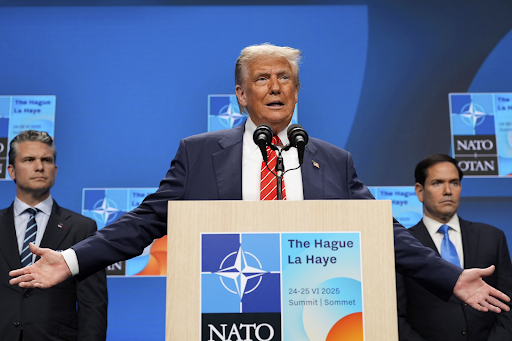
President Donald Trump speaks during a media conference at the end of the 2025 NATO summit. Source: NPR.
The North Atlantic Treaty Organization (NATO), a reciprocal defense alliance between 32 countries from Europe and North America, founded in the aftermath of World War II, has historically been led by the United States. Today, NATO is an important force in uniting the West in defense against Russian and Chinese aggression. However, the Trump administration’s transactionalist and imperialist approach to foreign policy and NATO membership is the antithesis of the alliance’s mission and founding principles of stability and cooperation, calling into question how NATO will survive as its strongest member undermines its credibility.
Armed with his “America First” agenda, Donald Trump has been making increasingly boisterous claims on the global stage and putting unprecedented strain on NATO as alliance members question the commitment of their strongest ally. Pushing for increased European defense spending, Trump loudly argues that the US shoulders an unfair burden of the organization’s budget and Europe is “freeloading.” In the same breath, he notes that Europe should be feeling the pressure to match U.S. defense spending amidst an escalated Russian threat. He said, “More important for them because, you know, we have an ocean in between.” Abandoning NATO’s foundational philosophy of collective, indivisible security through dialogue, cooperation, and consultation, these statements demonstrate how Trump has decided to take a transactional approach to NATO. Sliding further towards coercion, Trump has even framed the defense of allies as contingent on payment. He has repeatedly suggested that the U.S. might not defend “delinquent” allies and has even said he would “encourage” Russia to “do whatever the hell they want” to NATO states that do not spend enough on defense, directly contradicting the unconditional nature of Article 5.
NATO’s internal divisions are only intensifying as Trump has set his sights on taking control of Greenland, an autonomous territory of Denmark, a member of NATO. Trump has made multiple threats to annex the territory, including remarks that “one way or another, we’re going to have Greenland.” Leaders from Greenland and Denmark have interpreted Trump’s recent threats as a betrayal of the alliance and international law. Greenland’s Prime Minister Jens Frederick Nielsen said, “No more pressure. No more insinuations. No more fantasies of annexation… we are open to discussions. But this must happen through the proper channels and with respect for international law.” As Denmark’s Prime Minister, Mette Frederiksen, noted, Denmark, and thus Greenland, is a NATO member and covered by the alliance’s security guarantee. How is NATO expected to stay afloat when its most powerful member refuses to accept the territorial integrity of its own ally?
In the wake of the Trump administration’s volatile and hostile global strategy, leaders across Europe are questioning if this alliance remains reliable. The European Union has begun to rethink its defense strategy, with many leaders pushing for European strategic autonomy. As the EU’s top diplomat Kaja Kallas warned at the recent European Defence Agency Annual Conference, "The biggest change in the fundamental reorientation is going on across the Atlantic: a rethinking that has shaken the transatlantic relationship to its foundation," Kallas said, adding: "These developments put a severe strain on the international norms, rules and institutions enforcing them that we have built over 80 years. The risk of a full-blown return to coercive power politics, spheres of influence, and a world where might makes right, is very real." European Defense Commissioner Andrius Kubilius echoed Kallas’ sentiment at the conference. He said, “We live now in a world where might is right. Our answer to deal with this dangerous world ... European independence. European autonomy. More European responsibility for our own defense.” The EU has already taken action towards strengthening its autonomous defense capabilities, passing a €150 billion Security Action for Europe loan program providing financial support to member states to “speed up defence readiness by allowing urgent and major investments in support of the European defence industry.”
Whether European states will meet President Trump’s military spending demands may not be relevant. As Trump’s demands to European nations become more unreasonable, with Denmark being the paramount example, European leaders are realizing that there may not be a limit to Trump’s demands. The European leaders recognize that the era of the United States as a reliable guarantor of transatlantic security is over, regardless of how often and to what degree they capitulate to Trump. Accordingly, Europe’s move for a renewed continental defense policy should be viewed not as a short-term tactic, but rather a long-term strategy, permanently reducing American influence in the region.
By turning allies into adversaries and cooperation into coercion, Trump has managed to erode our most essential alliance, one that has anchored Western unity since 1949. As European leaders move toward greater defense autonomy, the transatlantic relationship that once defined the liberal order faces a decisive inflection point. Unless the United States rediscovers its commitment to the principles that forged NATO, the alliance risks collapsing under the weight of its own disillusionment.