
The Impact of Strained India-Bangladesh Relations
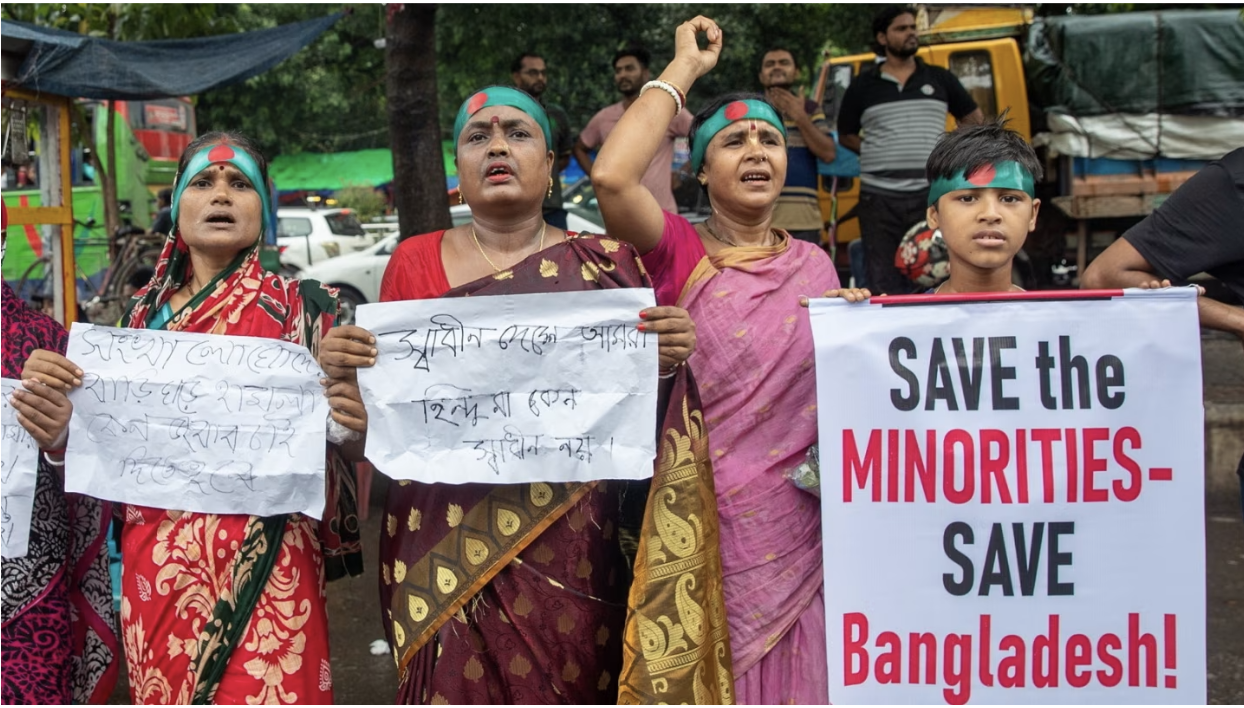
Women in Bangladesh protest against attacks on Hindu minorities. Source: The Financial Times.
India and Bangladesh have a long-standing friendship, starting in 1971 after India helped Bangladesh gain independence from Pakistan. The relationship grew throughout Sheikh Hasina’s 15 years as Bangladesh’s prime minister, with Bangladesh utilizing Indian ports and helping cement deeper ties between the countries. However, political upheavals in Bangladesh threaten to destroy the carefully curated relationship, and the aftermath has begun to bleed into both countries, becoming evident through changes in cricket and people’s daily lives.
On August 5, 2024, Hasina resigned from her position as Prime Minister and fled Dhaka after facing human rights abuse allegations, ordering the jailing of her opponents to stay in power, and pushing for brutal crackdowns on protests, which led to the deaths of 1,400 people. Following her resignation, she fled to India, where she has been in hiding despite calls from Bangladesh for her to return and face her death sentence—a ruling made by the International Crimes Tribunal after she was found guilty of crimes against humanity. Despite this, India has not made any effort at repatriation, leading to more instability as ethnic and political tensions between the countries continue to mount.
Consequently, attacks against religious minorities in both countries have risen. In Bangladesh, anti-India sentiment is familiar, and many citizens have been unhappy with India’s seemingly oppressive presence in the country. The governing BJP (Bharatiya Janata Party) in India strongly promotes Hindu nationalism, often looking away or even encouraging attacks against Muslims in the country. This sentiment, paired with India’s Prime Minister Narendra Modi’s continuous backing of Hasina and her oppressive tactics, has further angered the Bangladeshi people. This sentiment has become evident in the lynching and burning of Bangladesh’s minority Hindu population, including Dipu Chandra Das and the killings of Bajindra Biswas and Amrit Mondal. Burning Hindu homes has also become a common tactic, with eight houses being burnt down and one family intentionally locked inside before escaping. Similarly, growing Islamophobia has led to an increase in attacks against Muslims in the country, and authorities have resorted to destroying primarily Muslim homes through so-called ‘bulldozer justice.’ India has also taken federal measures against Muslims, with its 2019 Citizenship Amendment Act that excludes Muslims from the fast-tracking of citizenship, a clear religious ostracism. More recently, in May 2025, the BJP increased its campaign to remove Bengali Muslims in India to Bangladesh, typically in the form of unlawful deportation.
This political strain has begun to expand beyond the political sphere, now making a mark in the sports sector. Cricket, a traditionally celebratory sport in South Asia, has begun to reflect rising hostility, as Bangladeshi cricket player Mustafizur Rahman was recently ordered to be released from his team, the Kolkata Knight Riders in the Indian Premier League (IPL), by the Board of Control for Cricket in India (BCCI) just ahead of the tournament. The Bangladesh Cricket Board (BCB) has also banned the broadcast of the IPL in the country, and the government had voiced concerns over Bangladesh playing in the host country, India, asking for matches to instead be moved to Sri Lanka.
A force on the cricket global stage, India’s decision drew widespread shock and criticism from all sides. South Asia is a main stage for cricket diplomacy, usually between India and Pakistan, but with a friendly rivalry. But politics has begun to take the forefront in the game, outweighing any displays of sportsmanship. For example, Indian players refusing to shake hands with Pakistani players after matches and not accepting the Asia Cup championship trophy from the Pakistan ACC President reverses years of healthy competition within the sport, and violates the basic etiquette of sportsmanship that the game is built on. Committing acts such as these in the name of nationalism destroys the camaraderie of the game and has an influence on the future behaviors of both players and citizens.
In South Asia, cricket is regarded as a ‘religion,’ and the players are seen as role models both on and off the pitch. With such influence on the populations of both countries, citizens use the sport to inform their own actions, thoughts, and political literacy. If this is how fans see their beloved players behaving, they are more likely to pick up the same attitudes towards countries such as Bangladesh and Pakistan, fueling more cycles of hate. Within the sport, cricket will become less about the game and more about escalating or de-escalating political infighting.