
The Democratic Party’s Frontrunners for 2028
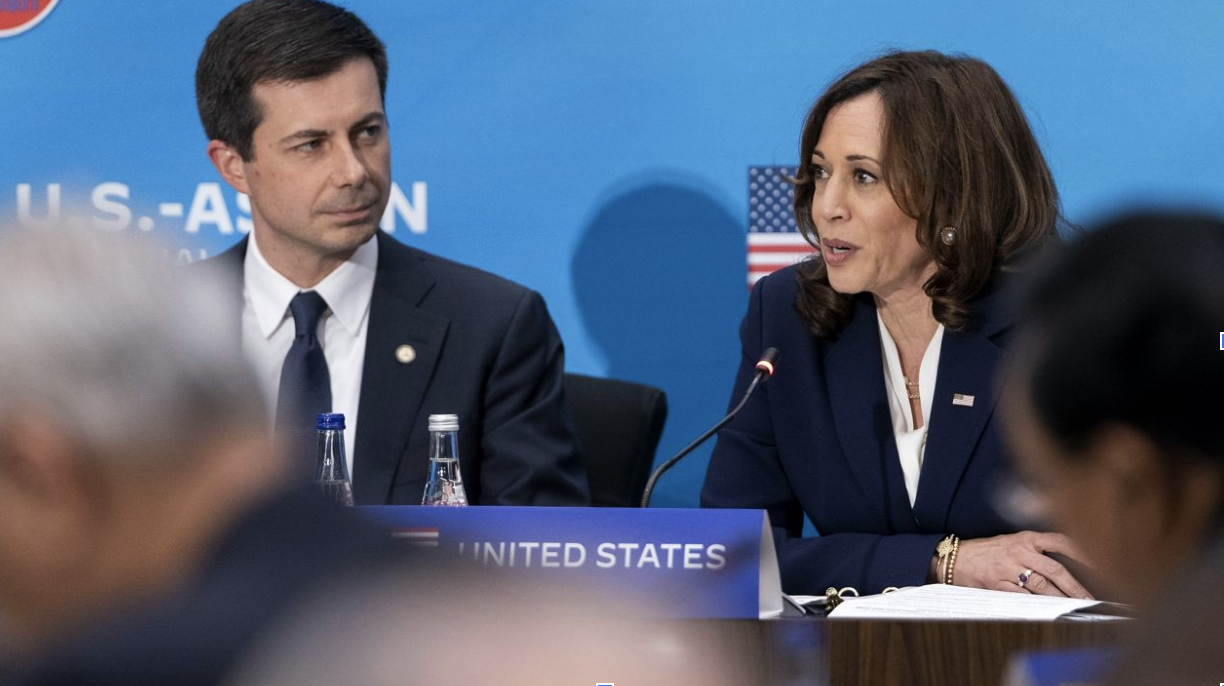
Pete Buttigieg and Kamala Harris are representing the U.S. in 2022 at the US-ASEAN summit. Source: Spectrum News.
The Democratic Party still has quite a bit of soul-searching to do after a full year into the second term of the Trump administration, but there is a recognition that this is no longer a time to lick wounds from the 2024 loss; instead, it is time to recuperate for the fight ahead: the 2028 Presidential Election. To do this, they need a true leader—one with stamina, party respect, charisma, and a positive track record. Who are the options? From the frontrunners, secondary candidates, long shots, and dark horses, here are the potential contenders for the Democratic primaries.
The Frontrunners
Gavin Newsom
Gavin Newsom, the two-term governor helming historically progressive California, had a busy 2025. Newsom arguably has the most evidence of doing things to combat Republicans since the 2024 election, hosting controversial guests on his podcast, leading the fight to gerrymander voting maps in California in retaliation to similar gerrymandering efforts in Texas, and trolling the Trump Administration via social media. Perceived by many in the party as action-oriented and putting purpose to anger Democrats feel due to the actions of the Trump Administration, his track record of leading California, a leading state in liberal legislation, is a point of promise. If he wins the nomination, he must learn to defend against the many critics of California’s plethora of unhandled issues, such as affordability. According to early polling, he is a frontrunner to hold the nomination.
Kamala Harris
Despite her loss in 2024, former Vice President Kamala Harris will have you know that she was under extraordinary circumstances and that the race might’ve shaken out differently if it had been on her terms. In her post-election memoir, she recounts that she had run the “the shortest campaign in modern presidential history” and isn’t done with politics yet. In October 2025, she said vaguely, but firmly, in an interview, “I am not done.” She still remains a party leader with notoriety, intraparty support, and strong communication skills. Though burdened by her ties to the chaotic last year of the Biden administration, with time and a campaign on her terms, perhaps Harris can learn from 2024 and emerge as a stronger candidate in 2028.
Pete Buttigieg
Buttigieg is an excellent communicator, with a calm and respectful mien. As Secretary of Transportation under President Biden, he built a reputation for speaking well under pressure and consolidating the message of the Democratic Party in hostile environments, even stumping for Harris in 2024 on Fox News and maintaining remarkable control of the conversation. Once a presidential candidate himself in 2020, he was seen as a top contender to be Harris’s running mate, but was not chosen because of Harris’s belief that America was not ready to have a Black female president and gay vice president. Though he has historically fared well with white, educated voters, what some call the “wine track,” to be a viable candidate in 2028, he has work to do with working-class and minority voters.
Secondary Candidates
Andy Beshear
The sole leader on this list with a track record of leading and succeeding in a deep red state, Andy Beshear, is somewhat of a unique case. The two-term governor of Kentucky was a former state attorney general and has guided the state’s recovery from economic turmoil and natural disasters. The word that comes up most when discussing his 2028 plans (he has yet to announce a run, but is expected to) is “electability,” and choosing a candidate who “has the best chance of beating J.D. Vance”, who is already seen by many as the leading candidate for the Republican Party’s nomination. Beshear, with his slight southern drawl, is moderate and measured, and doesn’t hold as much risk of being a polarizing figure—something that may be to his benefit.
Josh Shapiro
Once a potential vice presidential candidate for Kamala Harris, the Pennsylvania governor is known for bipartisanship and pragmatism. He has generally high approval ratings in his home state, which is known for being a key swing state in presidential elections which went for Trump in the 2024 presidential election. Since 2024, he has published a memoir—a telltale sign of a potential run for higher office—and was a victim of a firebombing attack at his personal residence. In his memoir, he paints himself as moderate, with opposition to some policies enforced by some Democrats, such as past comprehensive COVID lockdowns. Shapiro has been a strong supporter of Israel, a champion against antisemitism, and frequently invokes his Jewish faith as important to his leadership.
Alexandria Ocasio-Cortez
Rep. Alexandria Ocasio-Cortez is another contender with national recognition and a reputation for fighting back against the recent complacency of the Democratic Party as well as the actions of the Trump administration. Teaming up with Sen. Bernie Sanders in 2025 on their “Fighting Oligarchy Tour” in 2025, she is one of the few Democrats who took noticeable action in the wake of the 2024 loss. Proudly waving the flag of democratic socialism—a move that has worked astonishingly well for Mayor Mamdani in New York City—AOC’s characteristic progressivism has defined her image and career in Congress. Though regarded as too extreme by many in her party, her media-savviness and popularity with young people are assets to a potential campaign.
Long Shots
Ruben Gallego
Hailing from Arizona, Gallego brings over a decade of experience on Capitol Hill as a representative and now, as the junior senator representing the state in Congress since 2025. He is known for his strengths with working-class voters, not being afraid to break party lines, and present solutions as opposed to the strongly-worded, yet idle condemnations many Democrats seem to have an affinity for since the Trump Administration started. As a Latino man representing a border state, he has also made strong contributions to immigration measures, presenting to Congress impressive plans for reforms to the system.
Cory Booker
25. That’s the number of hours Senator Cory Booker spent from March 31, 2025, to April 1st, 2025, giving the longest speech in American Senatorial history, protesting the work of the Department of Government Efficiency (DOGE). The veteran lawmaker from New Jersey has a history of opposing the Trump administration and delivering on legislative goals in his 13 years as a Senator. He is a party leader, currently serving on the Senate Judiciary Committee and the Senate Committee on Foreign Relations, and has run for president once before. Booker’s history of receiving support from the pro-Israel political action committee AIPAC and supporting arms sales to Israel may upset younger voters.
Mark Kelly
Seen as a tough, almost gritty figure in the party, Mark Kelly, the former Navy pilot and NASA astronaut who represents Arizona in the Senate, was a final contender to be Harris’ running mate (sensing a common theme with the contenders). He has recently received praise for urging service members to disobey unlawful orders in a video with other Democrats in the aftermath of the Venezuela strikes. He is now fighting a Department of Justice inquiry into his conduct for that video. If he can project an agenda, his distinct service background could help him form a competitive campaign.
Wes Moore
Though he has insisted he is not running in 2028, anything can change in a few years. As the first-term Maryland Governor who is a combat veteran, Rhodes scholar, and former nonprofit executive, Wes Moore brings a lot of unique experience to governance. He was praised for his handling of the Key Bridge collapse in 2024, and is seen as an articulate, fresh face to the party that is being burdened by the reputation of being out of touch and geriatric. He still has experience to gain, but strong policy initiatives could help introduce him as a potential candidate to an unfamiliar audience.
JB Pritzker
The Illinois governor has a strong reputation of supporting robustly progressive legislation in his state and is a respected party member in his second term. Pritzker is also a billionaire (his family owns the Hyatt hotel chain). Though he has less notoriety, he has a very solid record and a history of building bridges within the party - for example, he has been a strong critic of ICE operations in Chicago, and welcomed Texas lawmakers for two weeks during their effort to prevent the passing of gerrymandered maps in the Lone Star state. He was also a candidate to be Harris’s running mate.
Dark Horses
Stacey Abrams
Though Abrams has not stated any intent to run for president, she has a wealth of experience in voter mobilization, state-level politics, and civil rights advocacy. She also holds name recognition and respect within the party. As a two-time Democratic nominee for governor of Georgia, Abrams has experience running a campaign that seeks to unite both red and blue-leaning voters in a swing state. Though she did lose by over 7 points in the 2022 gubernatorial election, her expertise is coalition building and grassroots initiatives, which would be valuable for bringing first-time voters into the electorate.
Jon Stewart
The television host of The Daily Show is known for his biting political commentary and for using his platform to criticize the absurdities of national politics. During the Trump administration, he, along with many other late-night hosts, has not shied away from relentlessly attacking everything from the firing of federal employees to the Epstein files. He has experience in legislative advocacy and supported the James Zadroga 9/11 Health and Compensation Act, even testifying before Congress about the rollout of the Act in 2019. Though he has said that speculation about him running for the nation’s highest office is due to “a shared feeling of helplessness,” there is concrete evidence that one can transition from television to the Oval Office.
The Democratic Party has a historically broad range—Representative Alexandria Ocasio-Cortez once said that “In any other country, Joe Biden and I would not be in the same party, but in America, we are,”—the challenge, for any candidate who covets the party nomination, will be to unite their party without creating intraparty conflict during the primaries or alienating non-Democratic voters in the general election. The Democrats need to clarify their platform and build a brand based on consistent, effective leadership, not just moral talking points backed with empty promises.