
The Fight for Senate Control in 2026 Hinges on Several Key Blockbuster Contests
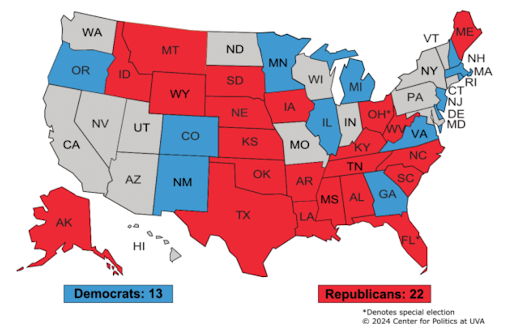
Current Composition of the Senate Seats up for Election in 2026. Source: Sabato's Crystal Ball
In November of 2025, the off-cycle election results showcased a reenergized Democratic Party in the face of the second Trump Administration. Democratic Governors Abigail Spanberger and Mikie Sherrill outperformed Kamala Harris’s 2024 margins in the blue-leaning states of Virginia and New Jersey in their gubernatorial elections. Meanwhile, Democrats have consistently overperformed 2024 margins in Congressional special elections. In this year’s upcoming midterm elections, the Democrats hope to capitalize on strong disapproval of the Trump Administration to take back control of Congress and send a strong rebuke to the White House.
The Republican Party currently holds a razor-thin majority in the House of Representatives of 218-214 seats, including three vacancies, with most election prognosticators favoring a Democratic takeover of the chamber. The Senate, however, poses a stronger challenge for Democrats. Republicans hold a 53-47 majority, with Democrats needing four pickups to gain the majority;Vice President J.D. Vance would break a tie in a 50-50 chamber.
The Class 2 Senate map, one of the three staggered Senate maps up for election every six years, provides Democrats with a mixed bag. They will have to defend 2 seats in states won by President Trump in 2024—Georgia and Michigan. Republicans also have to defend Senator Susan Collins’s seat in the State of Maine, a state which was won by Vice President Harris in 2024. A total of 35 Senate seats are up for election this cycle, including 20 Republican and 13 Democratic-held seats. As of January 2026, 9 senators have announced their intention to retire, which has injected additional uncertainty in the battle for control. Most Senate races do not appear to be competitive, being rated as “safe” for either party according to election prognosticators such as Sabato's Crystal Ball. However, the battle for Senate control is likely to depend on the outcome of 8 critical races. If the Democrats hope to retake the Senate, they must first defend three key seats.
New Hampshire emerges as the most reliable hold for the Democrats. This Senate seat is currently held by Democratic Senator Jeanne Shaheen, who is retiring at the end of her term. Representative Chris Pappas of New Hampshire’s 1st Congressional District is the frontrunner for the Democratic Nomination. Meanwhile, former Senator Scott Brown, who served as Massachusetts’s Senator from 2010-2013 and previously challenged Shaheen for this seat in 2014, is running on the Republican side. Brown is being challenged by another former Senator, John Sununu, who served in this seat from 2003 to 2009 before being defeated by Shaheen in 2008. While Sununu is regarded as a slightly stronger candidate for Republicans, both candidates face an uphill battle to flip this seat and defeat Pappas.
Additionally, Georgia is slated to be one of the Republicans’ biggest targets in 2026. After Governor Brian Kemp, possibly the strongest possible recruit for Republicans, passed on a bid, Representative Buddy Carter (GA-1), former Tennessee Football Coach Derek Dooley, and Representative Mike Collins make up the current Republican field. Democratic Senator Jon Ossoff, this cycle’s most prolific fundraiser, is running for re-election. While his race remains competitive, the Republicans’ failure to court Kemp into a Senate Run and Ossoff’s popularity make this race a tough flip for Republicans.
In Michigan, Democrats are facing more difficulties to hold this contest than in Georgia or New Hampshire. This senate seat is currently held by retiring Democratic Senator Gary Peters. After losing by just 0.2% in 2024 to then Representative Elissa Slotkin, former Representative Mike Rogers is hoping to flip this seat. The Democratic side has three viable candidates: U.S. Representative Haley Stevens, State Representative Mallory McMorrow, and Dr. Abdul El-Sayed. Stevens has carved a spot in the establishment lane, El-Sayed is running as a progressive option, and McMorrow is hoping to capture voters somewhere in between. All three candidates are carving themselves a unique pathway to the nomination. The uncertainty in this primary has some Democrats nervous about holding the seat. Yet, Republicans haven’t won a Senate seat in Michigan since 1994, and 2026 is likely to be a friendlier national environment to Democrats than 2024; nevertheless, this seat is the Republicans’ best shot of flipping a Democratic-held Senate Seat.
Since holding all three of these contests only keeps Democrats at 47 Senate seats, they must win contests in more hostile territory. Due to prolific candidate recruitment, North Carolina emerges as a promising opportunity for the Democrats to expand the map. North Carolina’s Senate seat is held by Republican Senator Thom Tillis, who is retiring after criticizing the Trump Administration and voting against the “Big Beautiful Bill.” As a result, President Trump has endorsed former RNC Chairman Michael Whatley to carry the Republican mantle in this state. In one of the biggest Democratic recruitment victories of the cycle, former North Carolina Governor Roy Cooper decided to jump into the race. Cooper has led recent polling based on his popularity as governor and much higher name recognition than Whatley. With Cooper's candidacy, having never lost a statewide election, Democrats feel confident about winning an NC Senate seat for the first time since 2008. A Cooper win here would have major implications; It would represent a major electoral breakthrough for Democrats in the fast-growing Sun Belt and bring major momentum in positioning North Carolina as a battleground in both the Senate and the presidency in 2028.
Unlike North Carolina, Maine is a unique contest where a Republican Senator has held on in a state that has not voted Republican for President since 1988. Senator Susan Collins has been an elusive target for Democrats hoping to flip the last Republican-held Senate seat in a consistently blue-leaning state. While Democrats feel optimistic about this year finally spelling the end of Collins’s political career, her ability to win senate elections in Maine five times says otherwise. Democrats have a competitive primary that symbolizes the intra-party conflict between the establishment and populist wings. Governor Janet Mills is the establishment-backed candidate, whereas Fisherman Graham Platner has platformed a strong anti-establishment candidacy. While this race appears to be a toss-up, Democrats must secure a victory here if they hope to take back the Senate.
The next few contests require Democrats to win in states that President Trump all won by double-digits in 2024. While Democrats remain underdogs in all these seats, stellar candidate recruitment has put them in a strong position to run competitive races in all these states. Ohio, a historical battleground that has shifted Republican in the Trump era, is a promising target for Democrats. After Senator J.D. Vance was sworn in as Trump’s Vice President, Ohio Governor Mike Dewine appointed Lieutenant Governor Jon Husted to serve until a special election for this seat could be held this year. Husted, a relatively mainstream Republican, has done little to alienate the GOP base, and enters this year in a strong position. Former Senator Sherrod Brown, who lost reelection in 2024 by 3 points, decided to enter this contest in the hopes of becoming the first senator to lose reelection and successfully stage a comeback since Slade Gorton (R-WA) in 1988. Brown has a strong electoral history in the state and brings this race onto the board after overperforming Harris by 8 points statewide in 2024. While Husted is narrowly favored, Brown’s focus on populist, pro-union rhetoric in a heavy manufacturing state is the right type of message needed to bring Democrats hope of winning back red turf.
It’s hard to see under normal circumstances how Senator John Cornyn’s Senate seat could be in danger after Trump won the state by nearly 14 points in 2024. Yet, the Texas Senate race could come into play under perfect circumstances for Democrats. Cornyn is being challenged to his right by embattled Texas Attorney General Ken Paxton, who has faced multiple ethics investigations and was even impeached by the Republican-Controlled Texas State House. On the Democratic side, State Representative James Talarico has proven himself a rising star within the party, running a populist campaign. Representative Jasmine Crockett is also running on the Democrats’ side and has been attacked by the Talarico camp for her electability. The primary has become one of the most divisive on either side as Crockett has pinned Talarico’s criticisms as racially motivated, while Talarico himself has stated her combative style is unlikely to persuade enough Trump voters needed to win this seat. While Texas has not voted statewide for a Democrat since 1994, Democrats got a close taste of victory with Representative Beto O’Rourke nearly upsetting Sen. Ted Cruz. Should the stars align for Democrats with a Paxton and Talarico matchup, don’t rule out the possibility of a blue Texas.
Similar to Texas, Alaska has just the right ingredients to become the dark-horse contest for Democrats to gain a sleeper flip in the Senate. Republican Senator Dan Sullivan, a relatively unknown mainstream republican, is running for reelection. Democrats scored their dream recruit in Representative Mary Peltola, Alaska’s first indigenous member of Congress. What makes some Democrats more pessimistic is that Peltola recently lost reelection as an incumbent representative in 2024. Early polling has suggested a tight contest with Peltola taking narrow leads. The key for Peltola is keeping the race localized in Alaska, as President Trump has carried the state in all three of his bids. Peltola’s popularity and Sullivan’s inability to energize the Republican base may allow Democrats a Senate majority through the Last Frontier.
Nebraska’s Senate Race is unique among the rest in that the Democrats are unlikely to field a candidate. However, the Nebraska race could still be up for grabs and aid Democrats in their quest for Senate control after Independent Union Leader Dan Osborne announced he would challenge incumbent Republican Senator Pete Ricketts, who won a special election to fill the remainder of Senator Ben Sasse’s term. Osborne’s independent label and the Democrats' decision not to field a candidate are unorthodox decisions with enormous upside. In fact, Osborne previously challenged incumbent Senator Deb Fischer in 2024, losing by 6 points while Trump won the state by over 20 points. While Osborne has not officially stated which party he would caucus with, it would be to the Democrats' advantage, nonetheless, if Ricketts were defeated.
The 2026 Senate Elections are a challenging fight for Democrats hoping to regain control of the upper chamber. Democrats should expect to receive a floor of 44 Senate seats and Republicans 47. The math poses challenges to the Democrats, who have to win 7 of these races to gain a majority in the Senate; Republicans only need to hold 3. While Democrats have a strong chance to hold all their current seats and make gains by climbing to 49 seats, specifically in North Carolina and Maine, they must pull off at least 2 victories in hostile red-state territory. Republicans still maintain the edge for Senate control, but don't rule out the possibility of a Democratic majority if President Trump remains deeply unpopular.