
Should the Worlds of Pop Music and Politics Collide?
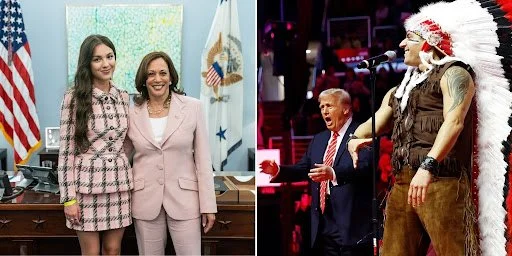
Left image: Olivia Rodrigo poses with former Vice President Kamala Harris at her West Wing office in the White House on July 14, 2021. Source: Wikimedia Commons.
.jpg)
Right image: Javier Perez of The Village People performs on stage as President Donald Trump dances at his pre-inauguration rally on January 19, 2025, at the Capitol One Arena in Washington, D.C. Source: Good Morning America.
Alongside its mass appeal, pop music is a highly versatile genre that communicates messages on a range of subjects, including politics. Pop songs influence many facets of societal behavior, such as fashion trends, consumer habits, slang, and general perception of political events. People from all walks of life enjoy listening to a variety of pop artists, including politicians. However, when politicians incorporate their music tastes into political messaging, they can violate copyright laws, alter a song’s original message, and affect an artist’s reputation either positively or negatively. With those scenarios in mind, it is worth pondering this question: What is the significance of an artist denouncing the usage of their music in political campaigns?
Since his 2016 presidential election campaign, President Donald Trump has used popular songs to drum up excitement at his rallies, private events, and around his policies. Some musicians have approved of him to use their music, such as the Village People and Lee Greenwood. For the most part, however, musicians have denounced the Trump administration’s usage of their music. So many, in fact, that there is now a Wikipedia page listing every artist who has made statements against Trump using their music. One of the most recent additions to that page is Sabrina Carpenter, one of today’s most popular musicians.
On December 2nd, the White House posted a video to its social media accounts showing ICE agents arresting individuals in their communities. The post’s caption was, “Have you ever tried this one? Bye-bye,” which references Carpenter’s song “Juno” and urges undocumented immigrants to immediately leave the U.S. Carpenter quickly condemned the post by commenting on X/Twitter. She said, “This video is evil and disgusting. Do not ever involve me or my music in your inhumane agenda.”
The White House account deleted their video shortly after, but not before making a statement defending it. The account said, “Here's a Short n' Sweet message for Sabrina Carpenter: we won't apologize for deporting dangerous criminal illegal murderers, rapists, and pedophiles from our country. Anyone who would defend these sick monsters must be stupid, or is it slow?” Short n’ Sweet is Carpenter’s sixth album, and the “stupid, or is it slow” line references another one of her lyrics from a different song called “Manchild.”
Carpenter is not the only artist to have recently denounced the usage of her music for the promotion of ICE’s agenda. One day after, on December 3, Joey Valence of the duo Joey Valence & Brae voiced disgust at the Department of Homeland Security using the song “Hooligang” to promote ICE recruitment on social media. SZA did the same thing the following week, when the White House account posted a video with her song “Big Boys” to warn of upcoming detainments. She called the Trump administration’s way of using music a form of rage-bait and said their attempts were “evil n boring.”
The use of music in political campaigns did not start with the advent of digital media; candidates and voters alike have used music to push political stances since the U.S.’s first presidential election in the late 1780s. Official presidential electors, not commoners, voted in the first election. Still, supporters of George Washington made their own parodies of songs like “God Save the King” (changed to “God Save Great Washington”) to promote the U.S.’ new beginnings as an independent nation. Subsequent presidential elections often saw the creation of original jingles for candidates. Starting with Ronald Reagan’s re-election campaign in 1984, popular songs became the go-to music choices for presidential candidates. Reagan’s campaign song was “God Bless the U.S.A.,” which Greenwood approved of and performed at the 1984 Republican National Convention. But for as long as presidential campaigns have incorporated pop music into their platforms, artists have called out candidates who use their songs without explicit permission. For example, Tom Petty sent a cease-and-desist letter to George W. Bush and demanded that he stop using his song “I Won't Back Down” for his 2000 presidential campaign. Sam Moore of Sam & Dave also sent a cease-and-desist letter to Barack Obama in 2008, demanding that he not use the song “Hold On, I'm Comin” at his rallies. Even as far back as 1984, Reagan had two artists denounce his usage of their songs in his campaign: Bruce Springsteen with “Born in the U.S.A.” and John Mellencamp with “Pink Houses.”
When it comes to copyright law, people can generally use popular music in their content as long as it adheres to the “fair use” doctrine, which permits the usage of copyrighted music for noncommercial purposes and with the intent of creating substantive work in the commentary, research, educational, or journalistic spheres. However, the “fair use” doctrine as applied to political campaigns carries much greater legal dilemmas. The way that a politician uses an artist’s song can alter public perception of said song’s content and artistic merit. Without obtaining permission from artists and other copyright holders before using songs in political campaigns, politicians not only risk violating copyright. They also risk destroying an artist’s reputation, particularly if the music gets used in ways that the artist would never say “yes” to. Therefore, artists such as Lionel Richie, Lorde, Elton John, and Green Day signed a letter in 2020 with the Artist Rights Alliance, which demanded that politicians not use their music in their endeavors unless they receive explicit permission from artists and other copyright holders, such as songwriters.
Not every artist wants to get involved in politics, and some Americans avoid posting about politics due to misinformation, polarization, and occurrences of cyberbullying. Even so, there is the expectation that celebrities voice their stances on different issues on social media. When an artist does not speak on a particular administration or issue, it can be seen as either a form of protecting one’s reputation or a subtle sign of endorsement. Artists such as Joey Valence & Brae and Olivia Rodrigo have made their disapproval known by not only making statements, but also using copyright law to get their songs removed from the DHS’s and White House’s posts. Although one artist whose silence has been widely noted is Taylor Swift, whose songs have been used in multiple TikTok posts promoting Trump’s presidential status.
Swift endorsed Harris in the 2024 presidential election and has spoken out against Trump several times. As of late, however, she has abstained from commenting on the Trump administration’s usage of her songs “The Fate of Ophelia,” “Father Figure,” and “Opalite.” Her silence has largely been interpreted negatively, with many netizens viewing it as either a sign of indifference or a subtle endorsement of the content.
Posts are questioning why Swift’s lawyers are more willing to go after Etsy creators than the Trump administration. There is an ongoing debate about whether Swift is a genuine activist or a performative one who only speaks on events directly affecting her. Some social media users have stated that her speaking out would pose risks to her physical safety, while others have pointed out that she has more room to speak out given her immense wealth as a billionaire. For the record, Swift once approved of Democratic Rep. Eric Swalwell using her song “Only The Young” in one of his 2020 political campaign ads.
Despite the controversy and derision, the Trump administration has continued to use popular songs and memes in its social media content. A few days after Sabrina Carpenter denounced their usage of “Juno” back in December, the White House posted a clip from her Saturday Night Live promo video that was altered to say, “I think I might need to arrest someone for being too illegal.” The actual line was, “I think I might need to arrest someone for being too hot.” The DHS themselves also admitted in a statement, “We will reach people where they are with content they can relate to and understand, whether that be Halo, Pokémon, Lord of the Rings, or any other medium.”
The divided reactions to mixing pop music and politics prompt greater questioning about the influence celebrities have over society and whether they should have it. Their immense wealth and power mean that, regardless of how informed they are about global affairs, politicians can rely on them to mobilize their voter base, attract certain voter demographics, and emotively convey their messages. Though the question is, should celebrities wield that kind of power, and if so, how should they use it? The answer remains inconclusive, but with the direct and indirect ways celebrity culture has influenced political debates, all sides make valid points.