
Anti-Government Protests Erupt In Prague Calling for the Prime Minister’s Resignation
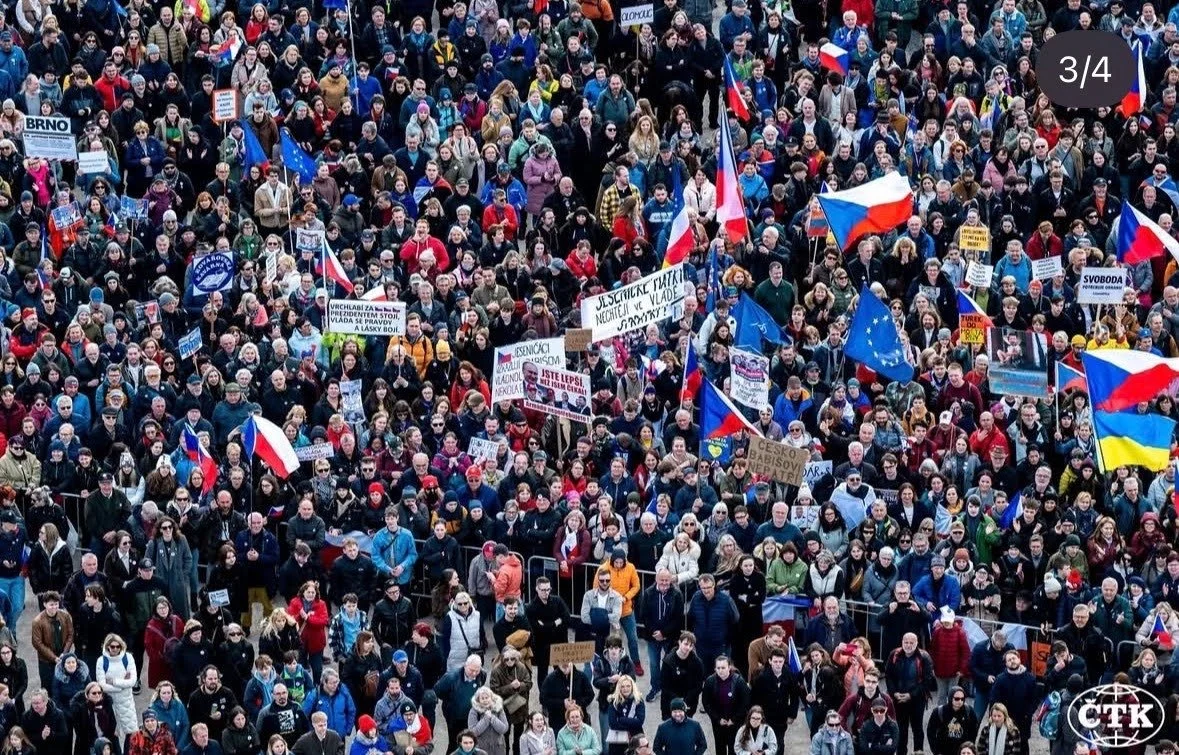
200,000 people gather in Prague’s Letna Park to protest against Andrej Babiš. Source: Czech News Agency.
Seldom is there political opposition in the Czech Republic on a massive scale. Only two major protests against the government have occurred in the country's modern history: first in 1989, when the infamous Velvet Revolution brought an end to the reigning communist party of Czechoslovakia; and the second in 2019, against Prime Minister Andrej Babiš, who had been accused of corruption. 2026 brings yet another mass protest. Between March and April, tens of thousands of people have gathered in and around Prague to protest against Babiš and his government, again. The result of these demonstrations has been peaceful, but the message is clear. Fears are mounting that the country is drifting from its democratic identity toward a more autocratic course.
On December 9, 2025, Andrej Babiš, who had previously led the government from 2017 to 2021, returned to office once again as Prime Minister. A member of the right-wing ANO 2011 party, he formed a coalition government with both the far-right SPD and the anti-environmentalist Motorists for Themselves parties. Immediately assuming office, Babiš adopted a “Czech first” (Česky napřed) approach. This included several policy changes, most notably his decision to stop direct financial support for Ukraine. He further advocated for stricter border controls and opposed the extension of EU emission benchmarks as outlined in the EU’s emissions trading system (ETS2). Concerns grew among Czechia’s relatively large pro-Ukraine and pro-EU communities on November 6, 2025, when Tomio Okamura, the right-wing Czech-Japanese speaker of the Chamber of Deputies, ordered the removal of the Ukrainian flag from the parliament building in Prague, which had been hung since 2022.
This sparked intense debate among lawmakers, but real opposition only began to shape in 2026, with President Petr Pavel becoming involved. In early 2026, the Motorist Party proposed Filip Turek to become Minister of the Environment. President Pavel, who has the right to approve appointments to the cabinet, refused to appoint Turek due to his past involvement in trivializing Nazi-era atrocities. The event reached its breaking point when President Pavel accused Foreign Minister Petr Macinka of sending text messages that appeared to be “blackmail.” In return, Macinka accused Pavel of violating democratic norms. To end the deadlock, President Pavel later appointed a different candidate, but the conflict undermined public confidence and did not go unnoticed by the broader population.
Last month, “Million Moments for Democracy” (Million chvilek pro demokracii), a Czech political organization, organized a protest in Prague’s Letná Park, amassing over 200,000 people. Mixed with EU, Czech, and Ukrainian flags, along with signs, the focus was not only to support President Pavel, but to show the government that there is a strong public desire to protect free speech and democratic processes. The future of Czechia under the Babiš administration still looks bleak. Not only is the government preparing a bill that would require nongovernmental organizations involved in political activity to register or face large fines, but the media has also been threatened with a change to funding. A further concern is that the lower house of parliament has also rejected a motion to lift immunity from prosecution of Babiš in a $2 million fraud case involving EU subsidies.
What makes these protests consequential is that their recurrence suggests the state of Czech democracy. When a country has seen only a handful of defining mass mobilizations in its modern history and now experiences another large anti-government protest within such a short historical span, it signals that public trust in the normal channels of democratic accountability is beginning to erode. For Czech youth in particular, this moment is politically formative. This is a generation that was raised after communism, that sees democracy as something fragile, that must be protected. Democracy in Europe is no longer an inherited fact, and the Czech Republic is no exception. This shift matters because it turns the stories of 1989 from national history into a living warning about how democratic norms can weaken with institutional intimidation.
For the government, the protests are more than a temporary legitimacy problem, as they reveal that confrontational politics may have the opposite effect, uniting citizens across generations under a common language of democratic protection. For the nation as a whole, the reappearance of mass political protest raises a question of whether the country is entering a new political era in which democratic identity must be constantly reassessed. It is in this sense that these protests are not only targeting Babiš, but are a warning that Czech democracy has entered a more contested phase, one in which the public is once again being asked what kind of republic it wants to remain.
For the future of Czechia, the March protests point to growing unease about the direction of the country’s politics rather than a singular turning point. While comparisons to 1989 are invoked in the media, these new demonstrations reflect a dynamic, one with a younger generation, shaped by post-communist stability, now confronting what they perceive as the erosion of democratic norms. Their participation suggests that democracy requires active defense in the modern world. For the time being, much of the governmental response will play out within parliament, where opposition parties must translate public discontent into concrete policy alternatives. At the same time, the protests signal to the Babiš government that its approach to governance is generating sustained resistance. Whether this moment leads to meaningful political change will depend less on symbolic appeals and more on how effectively both the government and opposition respond to the concerns now visible on the streets.