
Why the United States Is Returning to the Moon with Artemis II
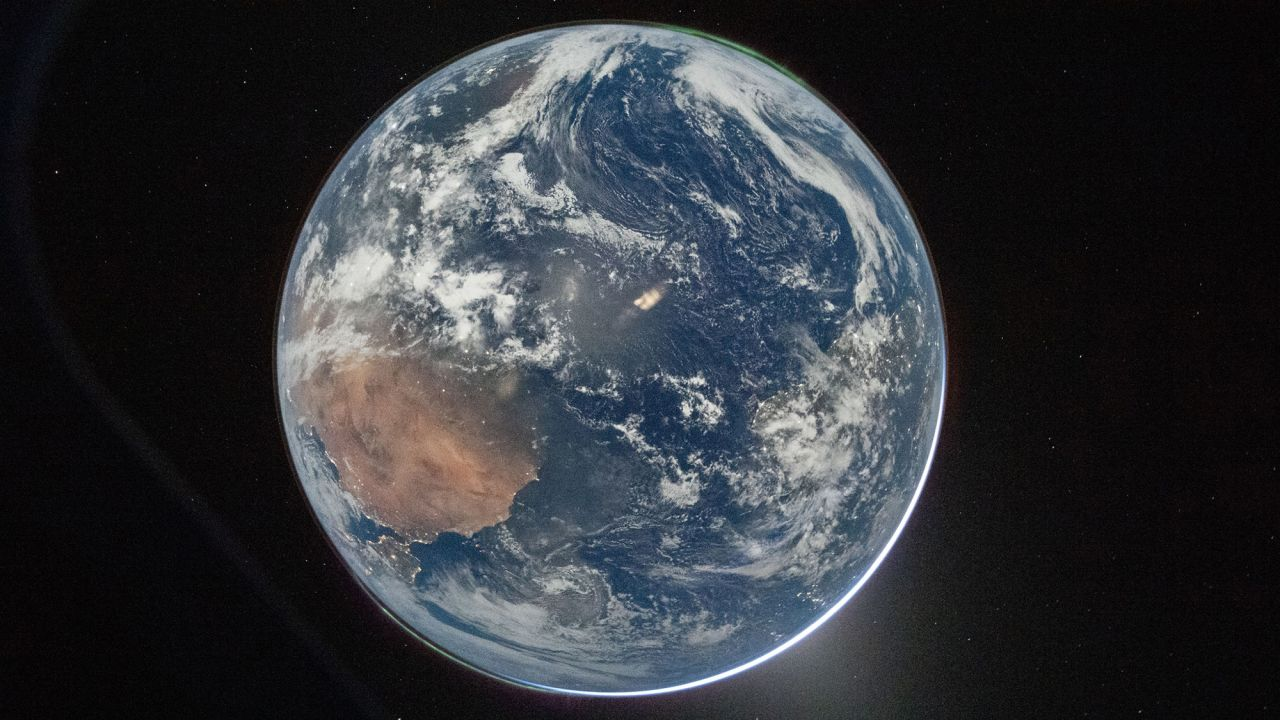
Photo of Earth taken from the window of the Orion spacecraft on April 2. Source: CNN.
On April 1, NASA launched its first crewed mission to the Moon in fifty years, since 1972’s Apollo 17. Aboard the Orion spacecraft, the four members of the Artemis II crew flew by the dark side of the Moon before returning to Earth on April 11. While no lunar landing is planned for this trip, the broader Artemis program aims to land humans on the Moon’s surface by early 2028, with the intention of eventually establishing a permanent lunar base as the launch point for the first crewed landing on Mars. NASA’s decision to return to the Moon in the 2020s is not arbitrary, driven rather by a rare alignment of domestic political continuity and renewed geopolitical competition.
To understand this shift, it helps to acknowledge what the Artemis II flight actually entails. Crewed by one Canadian astronaut and three Americans, Artemis II also carries a local connection; North Carolinian and NCSU alumna Christina Koch is among the crew, representing the state’s growing interest in space exploration (discussed in a recent Carolina Political Review piece). Further, the flight functions as a systems test at its core. Artemis II is designed to evaluate the Orion spacecraft in lunar orbit, the Space Launch System rocket that carries it beyond Earth, and the Exploration Ground Systems that coordinate the mission.
In that sense, Artemis II acts not only as a symbolic return to lunar space but also as an exciting aspect. Testing the mechanisms that enable space travel allows NASA to validate the infrastructure that future Artemis missions will depend on. That matters because the agency’s current lunar architecture builds toward Artemis IV, the mission now intended to return astronauts to the Moon's surface. In other words, Artemis II helps answer a basic question before a landing is even attempted: whether the systems needed to send humans around the moon and bring them home can perform reliably under real spaceflight conditions.
The long gap between the Apollo 17 and Artemis II missions is a product of a shift in the United States’ priorities after the height of the Cold War. The Apollo program’s Moon landings were viewed as crucial to establishing American dominance in the Space Race against the Soviet Union, proving the U.S.’s superior technological prowess in a struggle for international influence between the two superpowers. But once the United States had effectively surpassed the Soviet Union, the political capital behind further lunar flights evaporated, and NASA faced dramatic budget cuts in the early 1970s, resulting in the cancellation of the Apollo 18, 19, and 20 missions. Since then, the lack of funding for new expeditions has proven a crucial barrier for NASA’s efforts to return to the Moon.
Additionally, shifting domestic politics has made long-term planning for another Moon flight extremely volatile, with different presidents placing emphasis on varying aspects of U.S. space policy. For example, Republican presidents like George H.W. Bush, George W. Bush, and Donald Trump have been attracted to the Cold War-era rationale of using Moon landings to prove U.S. technological prowess on the world stage and have largely supported new Moon missions as a consequence. Democratic presidents such as Bill Clinton and Barack Obama, however, have focused on practical research interests in low Earth orbit, such as the International Space Station and asteroid sampling. However, President Joe Biden broke this pattern by sharing President Trump’s interest in another Moon expedition, allowing for three successive presidential terms of continuous planning for the Artemis program that made Artemis II a practical reality.
China’s increasingly active space program has likely contributed to this rare convergence of Presidents Trump and Biden on lunar exploration policy. Some scholars have argued that the United States is in a “New Cold War” with a Xi-era China interested in consolidating power on the world stage. For instance, President Biden’s 2022 National Security Strategy called the East Asian nation “the only competitor with both the intent to reshape the international order and, increasingly, the economic, diplomatic, military, and technological power to do it.”
Analyzing this geopolitical conflict through the lens of space exploration, China serves as a clear analogue to the Soviet Union in the “new Space Race,” with ambitions to land taikonauts (Chinese astronauts) on the Moon by 2030. This may explain part of NASA’s calculus in launching Artemis II now and planning the Artemis IV landing for 2028 by preempting China’s Moon voyage. The United States may again seek to prove its technological dominance to the world, just as it did to surpass the Soviet Union in the mid-twentieth century.
The return to the Moon can be understood as the result of a rare alignment in U.S. space policy, driven in large part by renewed geopolitical competition. In the decades following Apollo, the absence of a clear rival to the United States reduced the urgency of lunar exploration, while domestic priorities focused on lower-cost missions in low Earth orbit made sustained investment in Moon expeditions difficult. In recent years, however, China’s growing space capabilities have reintroduced external pressure, creating the conditions under which multiple administrations have supported a consistent lunar strategy. This convergence has made Artemis II possible in a way that earlier proposals were not.
The Artemis II mission represents less a sudden return to the Moon than the convergence of conditions that had long been absent from U.S. space policy. Whether that convergence persists will determine the Artemis program’s role in history, whether it will finally establish a permanent human presence on Earth’s orbiting partner, or whether it will fall into the now-familiar wax and wane of U.S. interest in lunar exploration. In the end, the answer will likely depend on the trajectory of U.S.-China strategic competition in the next decade.