
Pacific Patch Job: The New Zealand and Cook Islands Defense Pact
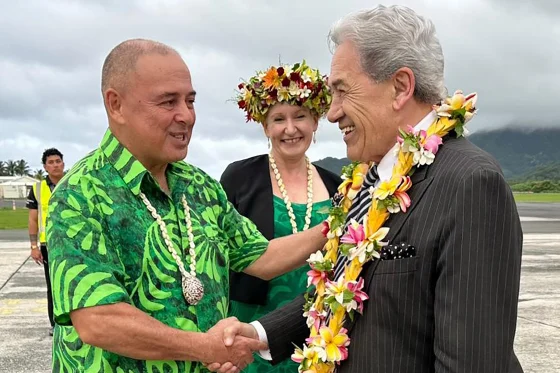
Cook Islands Prime Minister Mark Brown (left) greets New Zealand's Foreign Affairs Minister Winston Peters (right) as he arrives in Rarotonga. Source: NBC News.
On April 3, 2026, New Zealand Foreign Minister Winston Peters flew to Rarotonga to sign a defense and security declaration with Cook Islands Prime Minister Mark Brown. This formally ended more than a year of one of the most serious diplomatic ruptures in the two countries’ modern history. New Zealand had paused development funding, exchanged pointed public statements, and watched with anxiety as its smallest neighbor deepened its ties with China, a shift that raises concerns in New Zealand about strategic influence and security in a region it has long seen as its responsibility.
The Cook Islands have been in “free association” with New Zealand since 1965, a 60-year arrangement in which New Zealand handles defense, while Cook Islanders hold New Zealand passports and have the right to live and work across the Tasman. In return, the Cook Islands is expected to consult New Zealand regarding any international agreements that could affect shared security interests. This relationship has been built on mutual dependence and the assumption that the two countries are aligned.
However, this assumption broke down in February of 2025 when Prime Minister Brown traveled to China and signed a comprehensive strategic partnership with China regarding deep-sea mining, infrastructure, and educational scholarships. The issue was not the deal itself since it did not contain military provisions, but rather that Brown had not shared the contents with New Zealand beforehand. The Cook Islands argued that no such obligation existed, a position New Zealand disputed, and froze aid, catalyzing an icy relationship.
China’s courtship of the Cook Islands follows a familiar pattern across the Pacific. The archipelago has a vast and resource-rich exclusive economic zone, and Brown has been actively searching to explore the commercial potential of deep-sea mineral extraction. For China, the appeal is not the few thousand occupants on the island but the island’s geography, maritime access, and the slow accumulation of influence in a region often considered Western-aligned.
The new defense and security declaration gives New Zealand a formal commitment. Under its terms, the Cook Islands designates New Zealand as its “partner of choice” on defense and security. Both sides commit to regular talks and transparent information-sharing. New Zealand, for its part, commits to increased defense engagement and has resumed aid.
There are three reasons why this pact was reached now. First, both sides had made their point, and the standoff had reached the limits of its utility. Brown had already withdrawn his most contentious proposal, a separate Cook Islands passport, after firm opposition from New Zealand. Once New Zealand established that the agreement with China contained no explicit military provisions, its concerns appear to have eased. Under those circumstances, there was little to be gained from prolonging the freeze, particularly given the real diplomatic and practical costs associated with maintaining it. Second, Brown has secured what he wanted: The Cook Islands deal with China still stands. The new declaration with New Zealand explicitly doesn’t supersede the Cook Islands’ other arrangements, and Brown was clear that New Zealand would be his “first port of call” on defense, not his only port of call on everything else. Third, the optics of a fractured Pacific partnership are damaging for both sides at a crucial moment when the entire region is under scrutiny. A signed declaration, however imperfect, serves both governments’ interests.
The durability of this arrangement will depend on how both sides respond the next time Brown pursues an agreement with China that New Zealand regards as a security concern. The declaration creates a framework for consultation, but this only works when both parties believe that they are bound by it. Brown’s 2025 decision not to consult New Zealand was not a simple oversight but a deliberate assertion of the Cook Islands’ right to conduct its external affairs on its own terms. The new declaration may ease immediate tensions, but it does not suggest that this underlying political instinct has disappeared. Rather, a core tension remains: New Zealand continues to expect consultation on matters it considers strategically sensitive, while Brown appears determined to resist any practice that implies a limit on Cook Islands sovereignty.
This episode reveals a deeper structural tension in the Cook Islands-New Zealand relationship: New Zealand expects prior consultation on decisions with strategic implications, while Cook Islands leaders are increasingly determined to assert greater freedom of action in foreign policy. Small Pacific nations are increasingly unwilling to let their traditional partnerships constrain their foreign policy, and China is consistently offering an alternative. New Zealand may now have a formal declaration in hand, but it still lacks assurance that a future dispute will unfold differently if the Cook Islands again pursues an agreement with China that Wellington regards as strategically sensitive. The wider regional context in the Pacific is shifting, and formal agreements alone are unlikely to eliminate friction when the underlying interests of the parties remain unsettled.