
Does the Retreat of the US from the Global Order Mean the Rise of China?
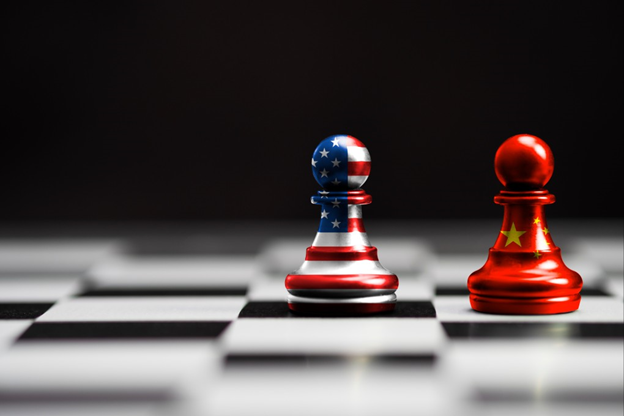
US-China and the Global Order. Source: SCAMP.
China is the world’s second-largest economy after the US, with a record trade surplus of $1.2 trillion in 2025. China’s economic and geopolitical influence will shape the order of the 21st-century world, which will impact post World War II alliances and the world order.
The US is often argued to be the foremost military power in the world. Its vast network of bases and alliances, approximately 750 military posts in 80 countries, allows it to project force globally in a way unmatched by any other country. Yet hard power is not only measured in military capability. It is also measured in credibility, consistency, and confidence in allies, which the scholar of International Relations, Joseph Nye, would term as soft power.
Changes to foreign aid policy and institutions such as USAID and the recent foreign policy decisions by the Trump Administration have unsettled America's long-standing allies. Tensions within NATO, alongside controversial positions on issues such as Venezuela, Greenland, and heightened tensions with Iran, have raised questions about the US position in the global world order. These foreign policy moves have raised broader questions about national sovereignty, power, and the role of the United States in the global order. The issue is not simply whether the US is retreating, but whether its leadership has become less dependable.
This shift is reflected in the behavior of US allies. European states and the United Kingdom, historically anchored to American leadership and the Cold War era world order, are increasingly engaging with China. The recent diplomatic engagement with China by many US allies, such as Canada, the UK, and Germany, may reshape the global order, reflecting growing European disillusionment and an isolationist approach away from the US.
The UK’s Prime Minister, Sir Keir Starmer, recently visited China, the first visit by a British Prime Minister since 2018, highlighting a broader economic pivot toward China among US allies. This visit aimed to normalize economic relations with China, triggered by the US tariff policy of the Trump administration. This points to the fact that US former allies are looking elsewhere to engage because of their economic benefits, and China seems to offer powerful incentives, including economic growth, technological development, and access to markets
“Like it or not, China matters to the UK”, said the UK Prime Minister Sir Keir Starmer. The New York Times Article reported that the Chinese and UK governments have agreed on bilateral business deals, including for British tourists to have visa-free 30-day trips to China. These negotiations reflect a broader trend of such states moving away from a Wilsonian promotion of liberal democracy towards the prioritization of free markets and privatization in pursuit of economic growth.
China’s ascendancy into the World Order as a key global shift is years in the making during the Deng Xiaoping era, where economic policies were put into place, and China joined the World Trade Organization (WTO) in 2002.
Is China ready to claim its position as a unilateral global power despite ideological differences between Western values and different political and economic structures? Do Chinese soft and hard power match the expectations of the world players, still dominated by the Western powers?
In 2023, Joseph Nye argued that soft power is the ability to get what you want through attraction, rather than coercion and payment. Since the dawn of the 21st Century, China has taken great strides to expand economic and cultural soft power through initiatives such as the establishment of the Belt and Road Initiative, Confucius institutions, and aid and development projects in Africa. However, the outcomes of these projects do not match the reality of China’s influence on other countries. According to a Sinologist, David Shambaugh of George Washington University, China spends approximately $10 billion a year on its soft power such as opening up the Confucius institutions around the world; however, such investment, China has not seen its ‘Return on Investment’ or negate what Eleanor Albert notes in her 2018 article, China’s Big Bet on Soft Power, writes about ‘peaceful rise and its vision for a harmonious society’. Nye observes that China’s authoritarian rule limits its soft power appeal.
When President Xi launched the Belt and Road Initiative (BRI) in 2013, it was described as a project of the world involving more than 100 countries with a $1.3 trillion investment. In an interview with the Financial Times, Le Yucheng, Chinese vice-minister for foreign affairs, said that in contrast to the trend of “rising protectionism, unilateralism, bullying and anti-globalization. BRI is an effort to build a fairer and more equitable international order and to reform the global economic governance structure.”
The flagship program of BRI is with Pakistan, with $64 billion investment in wind, solar, and investment projects in Pakistan.
As is often the case, rising powers expand their influence through alliances and territorial acquisition. For example, China is economically expanding through its territory. In 2017, China got the lease of Sri-Lankan Hambantota Port for 99 years, providing China with a foothold in the Indian Ocean.
To counter Chinese global influence, the EU launched its own version of a program named “Global Gateway.” Ursula Von Der Leyen, the current Commission President, said, “We want to create links and not dependencies,” signalling the debt trap of Chinese models, which offer state loans with interests that developing countries are unable to pay and create debt traps. Chatham House report observes that China uses the Belt and Road Initiative as a predatory, opaque enterprise, and as a threat to Western interests.
Maria Repnikova’s 2018 article in “China’s response to America’s retreat” argues that the US retreat from the global order does not automatically mean the rise of China. She supports her argument by stating that, despite the common view on Chinese expansion on its Road and Belt Initiative, there have been downward trends in Chinese investment overall, due to its domestic economic woes.
This poses the questions of how and in what manner China manufactures its soft power, not, as Nye says, through “voluntary attraction” but through economic coercion. This Chinese state behaviour is also true in many African countries that are under financial debt to China.
China’s soft power often relies more on material incentives than shared values. For example, China’s concept of Chinese-style modernization, non-interference, and multi-polarity does not provide a model that other countries can adopt. For example, the US model of development provided a template (life, liberty, and pursuit of happiness) coupled with a neo-liberal economy, rather than the Chinese state-structured control of all aspects of an individual's life. China does not want to shift such ideological principles, because that means revolt in China, and that would take the power away from the state-controlled mechanism, which suits the Chinese Communist Party (CCP). China’s economic strength is expected to remain a defining feature of the global economy into the next decade.
In short, while China is flexing its economic muscles through the Road and Belt Initiative, it is also investing in soft power through educational and cultural programs. One thing is for sure: China is not going anywhere in the Global Order. The question is not whether China will rise; it already has, but whether the United States can restore the credibility and consistency needed to sustain its leadership in an increasingly fragmented global order and gain the respect of its allies in the years to come.