
NC Lawmakers React to State of the Union
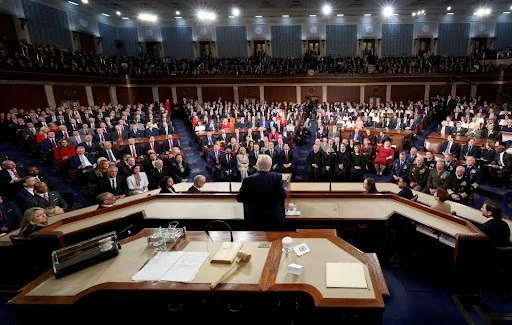
President Trump delivers the State of the Union Address. Source: OSV News.
In his State of the Union Address on February 24, 2026, President Trump presented a triumphant narrative of progress during his second term in office. He described the country he inherited from the Biden administration as in desperate need of saving, citing the economy, immigration, and culture wars. Now, he claims the United States is “bigger, better, richer, and stronger than ever.” Most of all, he said that the nation is in the midst of an economic turnaround and that “our country is winning so much that we really don’t know what to do about it.”
Throughout the speech, there were very few times when both Republicans and Democrats stood and applauded together. This stark display of partisan division reflects the current political climate in the United States. The reactions of North Carolina lawmakers to the address further reveal the depth of this political divide.
North Carolina Democratic lawmakers echoed the spokesperson for the Democratic Party, Governor Abigail Spanberger of Virginia, arguing that Trump’s claims do not align with the economic reality many Americans are experiencing.
Trump’s approval rating now sits at around 40%—a decrease from his average approval rating of 52% on Inauguration Day. A new Ipsos poll shows a 64% disapproval rate of Trump’s handling of tariffs and inflation, indicating that approval for the president’s management of the economy lags behind his overall approval rating. A recent High Point University poll in North Carolina reinforces this trend, in which the president’s highest disapproval ratings stemmed from his handling of inflation, the national debt, and tariffs.
North Carolina Democratic lawmakers argued that Trump neglected to address the economic concerns at the forefront of many voters’ minds, instead touting an economy that he claims is better than ever. Congresswoman Deborah Ross criticized the speech as a “giant slap in the face to every North Carolinian who is struggling to make ends meet,” and Wake County Democratic Party Chair Wesley Knott similarly stated that the President ignored the realities facing everyday Americans.
On the other side of the aisle, Republican lawmakers expressed unified support for the president’s policies, particularly regarding economic growth, border security, energy production, and tax relief. Richard Hudson, chairman of the National Republican Congressional Committee (NRCC) and a congressman, applauded Trump for his strong leadership and for delivering results that restored “strength, security, and prosperity for the American people.” Hudson, along with the Republican Party of the NC General Assembly's spokesperson, Matt Mercer, affirmed their party’s commitment to standing with President Trump and advancing his policy agenda.
This political polarization, reflected in diverging views of the nation’s economic condition, has adversely affected the functioning of North Carolina’s Republican-controlled General Assembly. North Carolina is currently the only state operating without a budget. Senator Caleb Theodros of the Charlotte area stated that North Carolina politics have become nationalized, with legislative energy focused on controversial federal legislation rather than delivering results for communities across the state.
After President Trump mentioned the stabbing of Iryna Zarutska in Charlotte during his address, renewed pressure mounted on representatives like Theodros to pass a state budget; without a complete budget, public safety cannot be adequately addressed.
In addition to highlighting divisions within the North Carolina legislature, responses to the address also shed light on the state’s representatives' future priorities. In November, Democratic candidate Roy Cooper and Republican candidate Michael Whatley will compete for the North Carolina Senate seat vacated by Republican Thom Tillis. The candidates hold diverging stances on inflation and affordability.
Cooper’s campaign prioritizes affordability and aims to combat inflation, making middle-class stability more attainable for North Carolinians. In doing so, Cooper is emphasizing cost-of-living issues that were largely absent from Trump’s address.
Whatley, on the other hand, is a Trump-endorsed candidate who supports the president’s tariffs and believes in his ability to bring inflation under control. He promotes himself as a “conservative champion for North Carolina,” who will be “an ally to our great president.”
This close alliance with Trump is a strategic move, as many Republicans have sought to endorse a candidate whom they know will support him. Thom Tillis, who chose not to seek re-election, faced criticism from both the President and members of his own party when he began breaking with Republican leadership on key votes, disagreeing with aspects of Trump’s policies, and working across the aisle to craft bipartisan legislation. Tillis’s experience can serve as a cautionary reminder for Republicans in North Carolina about the political risks of distancing themselves from President Trump.
In this way, the reactions to the 2026 State of the Union reveal more than simple disagreement over policy; they illustrate how national political divisions are shaping political discourse and priorities within North Carolina.